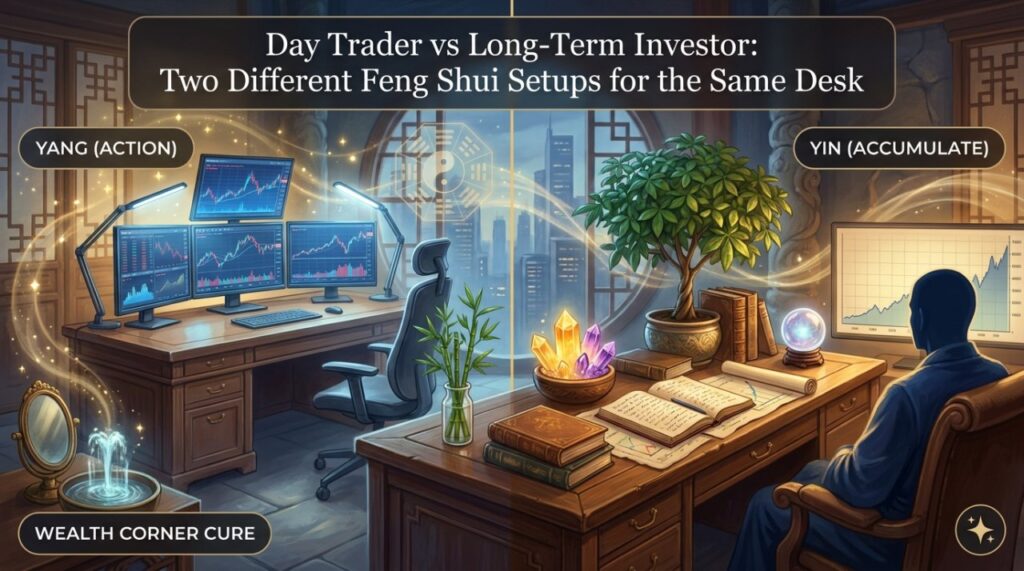
If you day-trade for 6 hours then research long-term positions for 2 hours, you’ve experienced what most traders never name: your desk should physically change between the two activities. Classical feng shui distinguishes between yang environments (action, decision, fast clearance) and yin environments (accumulation, reflection, patience). Active trading and long-term investing are opposite poles.
This is part of our trader feng shui series — start with the main stock-trader guide if you haven’t.
The core distinction: yang vs yin
| Day Trader (Yang) | Long-Term Investor (Yin) | |
|---|---|---|
| Lighting | Bright, cool (5000K) | Warm, lower (2700–3000K) |
| Desk surface | Bare, minimal — fast clearance | Books, journals, charts — accumulation |
| Chair | Upright, alert — slight forward tilt | Leaned-back, contemplative |
| Sound | Silence or rhythmic music | Soft instrumental, no rhythm |
| Direction faced | South / SE (active fire) | North / NE (accumulating water) |
| Wealth corner cure | Moving water (fountain) | Still water (small bowl) or crystal |
| Plants | Bamboo (fast-growing, light) | Money tree (slow, accumulating) |
For the active day trader
You need YANG dominance:
- Lighting at 5000K minimum. Warm lighting puts you to sleep in 90 minutes. Cool/daylight bulbs maintain alertness for 6+ hour sessions.
- Empty desk before the session. Yesterday’s notes go in a drawer. Each session starts on a blank field — same energetic logic as a chef wiping the cutting board between dishes.
- One small mirror on a side wall. Not facing you — facing the wealth corner. Doubles the activation of fast wealth qi.
- Rhythmic music optional. If you use music, instrumental with a clear beat (think electronic at 100–110 bpm). Vocal music splits attention.
- Face East or Southeast. These are the rising-sun directions; in classical Bazi they enhance the wood-energy needed for decisive action. (Year-specific overrides apply — check your 2026 forecast.)
For the long-term investor / value researcher
You need YIN dominance:
- Lighting at 2700K. Warm bulbs slow the nervous system. Slow nervous system → better long-form analysis. (The famous Buffett-letter-writing energy is yin.)
- Books visible on the desk. Stored knowledge = wealth foundation. Even if you don’t read them today, their presence anchors the energy of accumulation.
- Crystal cluster in wealth corner. Citrine or amethyst geode — stones grow over geological time, mirroring long-hold positions.
- One large plant — money tree or jade. Slow-growing, dense leaves. Visual reinforcement of “compound over time.”
- Face North or Northeast. Water-energy directions. Patience, depth, accumulation. (Check year-specific overrides.)
If you do both: the rotation trick
Most traders do both. Solution: use the SAME desk but visibly switch its state:
- Day-trading session: bright lamp on, drawer closed (books hidden), face east, music on.
- End of session: turn OFF bright lamp. Open the drawer to pull out 3 books on the desk. Turn ON the warm lamp. Re-orient chair if possible.
- Long-term research session: warm light, books visible, slow music, journaling.
Sounds theatrical. Works empirically. The brain takes physical cues to enter a different cognitive mode — same reason therapists tell insomniacs to “use the bed only for sleep.”
Common mistakes that mix the two badly
- Always-on bright lighting + research mode = analytical fatigue by hour 2. You’ll over-trade your long-term thesis.
- Cluttered desk during active trading = decision paralysis. The eye can’t find the entry signal.
- Books permanently displayed during active trading = “I should be researching instead of trading” intrusion thoughts. Hide them.
- Music with vocals during research = the language center of the brain that you NEED for reading research gets co-opted by lyrics.
2026 specific: timing your sessions
In a Fire year (2026 = Bing-Wu), morning yang energy is at its strongest. Day trading mornings (9am–12pm local) is favored. Long-term research benefits from late afternoon to early evening (3pm–6pm) when the day’s fire energy starts cooling. Avoid major position decisions between 11pm and 5am — yin hours are not for yang decisions, regardless of which mode you’re in.
FAQ
I only have one desk. Worth the rotation effort?
Yes. The mental cost of mixed modes is higher than the physical cost of switching lighting + clearing the desk. Even 30 seconds of explicit transition matters.
Two separate desks if I have the space?
Ideal if you have the room. Day trading desk in the yang corner (south/east of the room), research desk in the yin corner (north/west). Walking between them is itself a transition ritual.
What about swing traders (1–5 day holds)?
Hybrid. Lean yang during entry/exit windows, yin during the hold. Set a small physical signal on the desk during open positions — a single coin or token — and remove it when flat.
Does this apply to algo / quant work?
Yes, lean strongly yin. Algo development is research work even when watching trades execute live. Warm lighting, books, slow rhythm.
Continue the series: Crypto Trader Feng Shui →
FateFinder builds the calculators and reading tools that traditional Chinese Feng Shui masters use, in plain English and free to anyone. Our engines implement the same Shen-style Xuan Kong rules, Eight Mansions formulas, and Bazi calculations used in classical practice. Read our story →