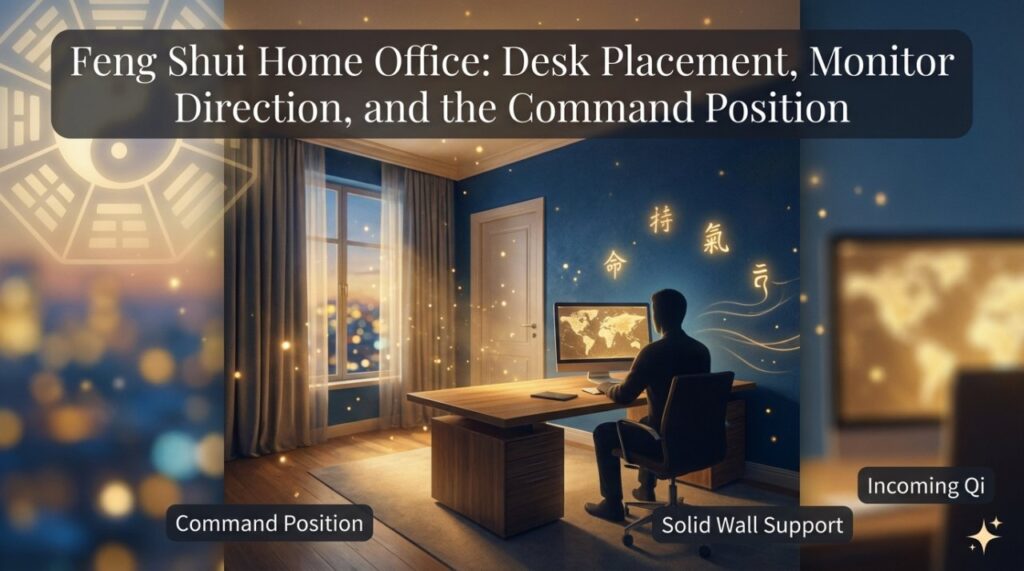
If you work from home, your desk position is the single highest-leverage Feng Shui decision in your entire home. It outweighs the front door, the bed, even the kitchen. Why? Because that’s where you spend 30-50 hours of conscious, decision-making energy every week. Get the desk wrong, and you accumulate low-grade stress that shows up as procrastination, distractibility, and undefined career drift. This guide is the practical version: the one principle that matters most (the command position), the directional rules that follow from your Bazi, and the small fixes that compound.
The command position — the only rule that really matters
If you only do one thing from this guide, do this:
Your desk should let you see the door of your office without turning your head. Your back should be against a solid wall — not a window, not a half-wall, not an open room. The door should be visible from where you sit, diagonally across the room rather than directly in line with you.
This is called the command position (命位), and it’s the most studied principle in classical Feng Shui. Three reasons it works:
- Nervous system: a meaningful chunk of your brain is constantly monitoring for threats from behind. When that monitoring can be relaxed — because you can see what’s coming — more attention is freed for focused work. This is provable physiology, not metaphor.
- Decision quality: people make worse, more reactive decisions when they’re physically vulnerable. A back-to-door desk is a low-grade vulnerability your body adapts to but never quite forgives.
- Authority signal: when others enter your office and you’re already facing them in a settled position, the energetic dynamic of every meeting is set in your favor before anyone speaks.
What the command position looks like
Picture your office floor plan from above. The door is on one wall. The ideal desk position is on the wall perpendicular or opposite to the door, with the chair facing into the room. You sit looking out, not in.
Variations that work:
- Diagonal-opposite (best): desk in the corner farthest from the door, chair facing diagonally toward the door. Maximum sight line, solid walls on two sides.
- Perpendicular wall (good): desk against the wall to the side, chair angled so you can see the door without turning.
- Direct opposite (acceptable, not ideal): desk against the wall opposite the door, you face it. Visible, but you’re aligned directly with incoming qi, which can be too forceful.
Variations that don’t work:
- Back to the door: the absolute worst — and the most common in poorly-set-up home offices.
- Back to a window: windows count as “no support.” Even if the view is gorgeous, you’re sitting with nothing solid behind you.
- Facing a wall close to your face: reduces creativity, creates a feeling of being boxed in. Want at least 1 meter of open space ahead of you.
“I can’t move my desk because of cables / outlets / room shape”
This is the most common objection, and it’s almost always wrong. Two minutes of honest evaluation reveals workable options. But for the cases where the room genuinely forces a bad position:
If you must sit with back to door
Place a mirror on the wall in front of you that reflects the door behind you. This restores the visual command position. The mirror should be small but clear — not a decorative mirror with frame distortion. A simple framed acrylic mirror, 15-30cm wide, mounted at eye level, is perfect.
If you must sit with back to window
Heavy curtains or blinds, kept partially drawn during work hours. Or: a tall solid object behind your chair — a bookshelf, a tall plant, a screen — that provides the missing “support.” A full bookshelf, not an empty decorative one. The mass matters.
If your office is a corner of a shared room
Use a screen, a bookshelf, or a tall plant to create a visual boundary on at least two sides of your desk. The boundary doesn’t need to be solid — it just needs to be visible. Your nervous system reads “this is my workspace” from clear visual cues.
Best desk direction by your Kua
Beyond the command position, the direction your face points while working also matters. Your monitor’s location determines this, since your face follows your monitor.
Use our Eight Mansions Calculator to find your Kua and your four lucky directions. Then:
| Best for… | Direction to face | What it activates |
|---|---|---|
| Career growth, wealth | Sheng Qi (生气) | Career advancement, opportunities, raises |
| Health, mentorship | Tian Yi (天医) | Recovery from burnout, mentor relationships |
| Relationships, partnerships | Yan Nian (延年) | Long-term contracts, partner deals |
| Focus, study | Fu Wei (伏位) | Stability, completion of long projects |
For most working people, Sheng Qi is the right choice for your primary work direction. Face it. If the room shape forces a compromise between command position and your Sheng Qi direction, the command position wins — it’s the bigger lever.
Monitor placement and the “second screen” trap
One large monitor centered on your line of sight, positioned at the top of the screen at roughly eye level. This is what your spine, neck, and Feng Shui all want.
Common traps:
- Laptop on desk with no external display — forces your head down, accumulates as cervical strain and a hunched posture that signals defeat to your own nervous system. Use a laptop stand or external monitor.
- Two monitors at awkward angles — every neck rotation per day is a micro-stress. Pick one primary monitor centered and use the second only for reference material you check occasionally, not for active work.
- Monitor against an open wall behind you — Feng Shui-wise, your screen radiates yang energy and that’s better directed forward into the room than into a wall. Keep at least 1.5m clear in front of your screen if you can.
Office colors
The home office should lean cooler and more stable than the rest of your home. The energy you want here is focused, not flamboyant.
- Earth tones (beige, soft yellow, light brown) — stable, grounding, supports concentration.
- Wood tones (sage green, light teal, natural wood) — gentle growth energy, easy on the eyes, conducive to creative thinking.
- Soft blue/grey accents — water-element calm; good in moderation.
Avoid:
- Dark navy or deep grey walls in the office — accumulates yin, hard to stay alert.
- Bright red walls — overstimulating; spikes cortisol over a long workday.
- Pure white “minimal” — sterile, drains creative output over time. Even a tiny amount of warm accent helps.
Cross-reference your Bazi favorable elements to personalize: if your day master favors Wood, lean greener; if Fire, allow more warm accents; if Earth, the beige/yellow range; if Metal, more white/grey is good for you specifically; if Water, deeper blues work where they’d be too heavy for others.
Five objects every Feng Shui office should have
- One healthy plant — living wood energy. Rubber plant, pothos, snake plant, or jade plant are forgiving choices.
- One solid, weighted object on the desk — a crystal cluster, a heavy paperweight, a small sculpture. Adds “earth” to the desk surface and gives you something to look at when thinking.
- Good lighting at three levels — overhead general, mid-level task light, and desktop lamp. Single-source lighting flattens the room energetically.
- Books or organized physical references — visible mass behind you (if you sit against a bookshelf) or to one side. Knowledge as anchor.
- One personal-meaning object — a photo of someone whose belief in you matters, an award, a memento from a moment of accomplishment. Feng Shui works through your subconscious; this is a daily reminder.
What to keep out of the office
- Treadmill or exercise equipment — Feng Shui considers these “draining” qi in a focus space. Separate room if possible.
- Visible bed or sleeping space — even an office-with-pullout-couch reduces office energy. Cover or screen the bed during work hours.
- Mirrors that reflect your desk (other than the command-position mirror behind you) — doubles your work load energetically. Many people unconsciously feel busier than they are because a mirror is reflecting their setup.
- Sharp objects pointed at you — corners of furniture, pointed plants (cacti), open shelving with hard edges all aimed at the chair. Soften them with curves, plants with rounded leaves, or repositioning.
- Heavy beams overhead — exposed ceiling beams over the desk compress qi onto the worker. Hard to fix without renovation; symbolic fixes include a fabric panel hung below the beam.
The “wealth corner” of your office
Most desks have a far-left corner from the user’s perspective. In simplified Feng Shui this is called the desk’s wealth corner. (In Classical Xuan Kong, the actual wealth corner depends on the building, but for desk-scale work, the far-left convention is widely used.)
What goes there:
- A small healthy plant (jade plant is classical)
- A vision-board card, financial goal note, or single business card with intent
- A small crystal — citrine for wealth, clear quartz for clarity
- A piece of personal-meaning art or text
Keep this corner deliberately clean and intentional. Clutter here = wealth that’s been “buried.” Spend 30 seconds tidying it daily; this is a higher-leverage micro-habit than most productivity tips.
Frequently asked questions
What is the command position in Feng Shui?
The command position is a desk placement where you can see the office door without turning your head, with a solid wall behind your chair and the door diagonally across from you (not directly in front). It reduces unconscious vigilance, improves focus, and signals authority to anyone entering.
I can’t move my desk — what’s the best fix?
If you must sit with back to the door, install a small mirror on the wall in front of you that reflects the door. If you must sit with back to a window, add a tall solid object (bookshelf, plant) behind your chair, or use heavy curtains. The visual logic of the command position can be restored without moving furniture.
What direction should I face when working?
Face your Sheng Qi (生气) direction for career advancement and wealth. This varies by Kua number — use our Eight Mansions Calculator to find yours. If room geometry forces a choice between command position and Sheng Qi, prioritize command position; it’s the bigger lever.
What color should my home office be?
Earth tones (beige, soft yellow), wood tones (sage, natural wood), and warm neutrals work universally. Avoid dark navy walls (too yin for daily work), bright red (overstimulating), and pure white (sterile). Personalize with your Bazi favorable elements for a custom palette.
Are plants good in a home office?
Yes — one healthy plant adds living wood energy, improves air quality, and provides a soft visual rest point. Rubber plants, pothos, snake plants, and jade plants are forgiving choices. Avoid spiky cacti (sharp qi) and any plant you’ll let die — dead plants generate strong negative qi.
Should my office be in a specific room or direction of the house?
Yes, if you have the choice. East and Southeast rooms are classically favored for offices (wood-element growth supports career). For Period 9 (2024-2043), South rooms also work well (fire element supports visibility and recognition). Avoid bedroom-as-office if possible; the dual-use compromises both functions.
Does the command position matter if I work remotely with no clients visiting?
Yes. The benefit is internal, not social — your nervous system relaxes when your back is supported and your eyes can see the entry. This compounds across thousands of work hours regardless of whether anyone else ever enters the room.
Next step
Find your Kua number and Sheng Qi direction with the Eight Mansions Calculator. Then layer your Flying Stars chart to see which palace of your home your office sits in — when an office sits in a wealth-star palace AND faces your Sheng Qi direction AND uses your favorable colors, you’ve stacked three layers of advantage on the room where you make your career.
FateFinder builds the calculators and reading tools that traditional Chinese Feng Shui masters use, in plain English and free to anyone. Our engines implement the same Shen-style Xuan Kong rules, Eight Mansions formulas, and Bazi calculations used in classical practice. Read our story →