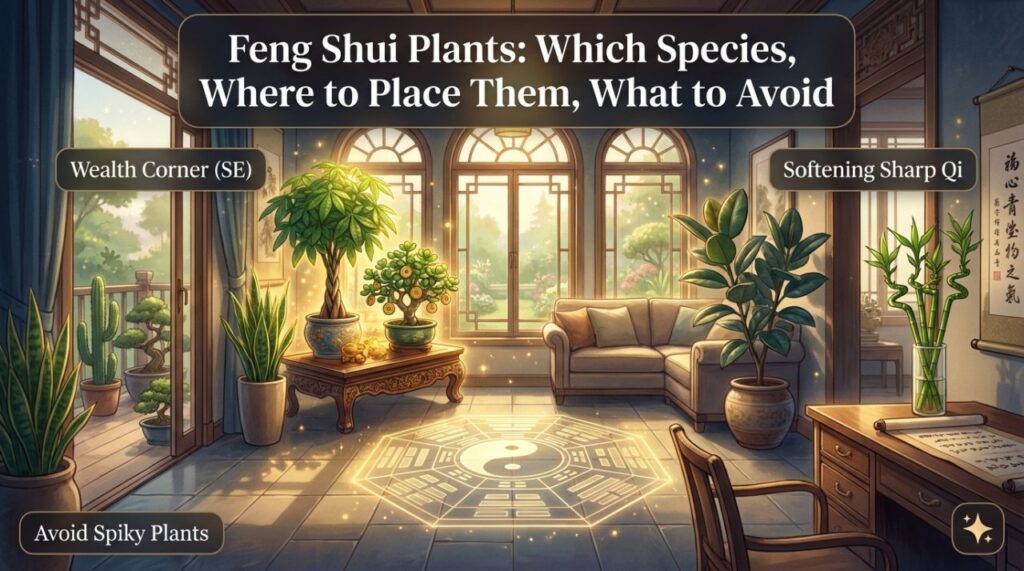
Plants are the easiest and cheapest way to upgrade a home’s Feng Shui — and the easiest way to accidentally make it worse. The classical schools agree on plants more than they agree on almost anything else: a healthy plant in the right corner activates wood energy, attracts wealth, and softens harsh corners. A dying plant, the wrong species, or the right species in the wrong room can drain qi worse than an empty corner. This guide walks through which plants Feng Shui actually recommends, where to put them, and the species and placements to avoid.
Why plants work in Feng Shui
Three layers of effect:
- Wood element activation. Living plants embody growing wood energy. In rooms or corners where wood is favorable (which depends on your Bazi and the room’s Flying Stars palace), plants channel that energy directly.
- Air quality and biophilic response. Modern environmental psychology confirms what classical Feng Shui asserted: human nervous systems calm in the presence of living plants, oxygenated air, and natural textures. Less folklore, more direct effect.
- Softening sharp qi. Plants with rounded leaves absorb the cutting qi from corners, beams, and sharp furniture edges. A plant in front of a column or sharp corner is one of Feng Shui’s oldest and most reliable remedies.
The 10 best Feng Shui plants
| Plant | Symbolic meaning | Best placement |
|---|---|---|
| Jade plant (Crassula ovata) | The classical “money plant” — round leaves like coins | Wealth corner (SE), home office, retail entry |
| Money tree (Pachira aquatica) | Braided trunk = wealth multiplied; needs five leaves per stem | Wealth corner, business entrance |
| Lucky bamboo (Dracaena sanderiana) | Cylindrical growth = persistent vitality. Count matters: 3 (happiness), 5 (health), 8 (prosperity), 9 (good fortune) | Office, study, east-facing rooms |
| Pothos (Epipremnum aureum) | Forgiving, fast-growing wood energy; cleans air | Sharp corners, high shelves, awkward gaps |
| Snake plant (Sansevieria) | Protective; sharp upright leaves convert negative qi | Entryway, bedroom corner (with caveats — see below) |
| Peace lily (Spathiphyllum) | Harmony, low-light tolerant, white flowers symbolize purification | Bedroom (low-pollen), bathroom, north-facing room |
| Rubber plant (Ficus elastica) | Substantial wood mass; signals stability + growth | Living room, office, ground-level corner |
| Orchid (Phalaenopsis) | Romance, refinement; long-lasting blooms | Relationship corner (SW), bedroom (single, not multiple) |
| Boston fern | Soft yin energy; cleansing | Bathroom, north or northwest room |
| Citrus (lemon, kumquat) | Fruit-bearing = wealth manifestation; fragrant | Sunny window, entry, balcony |
The 3 plants Feng Shui asks you to avoid
- Cacti and most succulents with spikes. Sharp leaves project hostile qi at people. Acceptable on a balcony or in an outdoor corner; not great indoors, especially in bedrooms or living rooms.
- Bonsai (in the home). A deliberately stunted living tree — symbolically arrests growth. Beautiful and meditative, but Feng Shui practitioners traditionally place bonsai outside the home proper, in a viewing pavilion. In modern homes, one small bonsai in a study is fine; a collection of them in the living room is not.
- Dried flowers and dead plants. The single most common Feng Shui mistake. Dead plant material accumulates yin and projects a “completed” energy that the home subconsciously matches. Toss dried bouquets; replace dead leaves on living plants immediately.
Room-by-room placement
Entryway
One healthy plant flanking the front door (inside or outside) signals “life lives here.” Snake plant, jade plant, or a citrus tree all work. Avoid plants that block the door’s full opening — qi entering the home shouldn’t have to navigate obstacles.
Living room
The living room can take the most plants — it’s the household’s social yang space. Anchor with one larger plant (rubber plant, fiddle-leaf fig, peace lily) and accent with 2-3 smaller ones. Avoid clustering all plants in one corner; distribute so qi flows through the room.
Bedroom
Old Feng Shui guidance said “no plants in bedrooms” — based on the idea that growing plants project yang activity and disturb sleep yin. Modern practice is gentler: one or two plants is fine, several is overstimulating. Best bedroom plants: snake plant (releases oxygen at night), peace lily, pothos. Avoid pollinating flowers in the bedroom (allergies + active romance disturbance for sleep).
The relationship corner of the bedroom (typically SW) is the one place a small flowering plant (single orchid) is classically welcome.
Kitchen
One plant in the kitchen, ideally near (but not on) the stove, to mediate the fire-water tension. Herbs in pots on the windowsill are excellent — they’re alive, useful, and provide wood energy between fire (stove) and water (sink).
Home office
One large plant, two if the room is big. The plant goes on the wall behind your monitor or in the corner opposite the door, not directly in your sight line during work. Full office guide here.
Bathroom
Plants in the bathroom serve a specific function: they absorb the downward “draining” energy of the room’s plumbing. Boston fern, peace lily, and pothos all tolerate the humidity. This is one of the few rooms where adding plants is unambiguously beneficial.
Wealth corner
The classical placement — far southeast corner of your living room (BTB school) or your home’s 8 White Wealth Star palace (Xuan Kong school). A single, deliberately chosen plant here — jade plant, money tree, or money plant — is one of the highest-leverage Feng Shui placements in the entire home.
Plant care = Feng Shui care
The single most important rule: a healthy plant activates qi; a struggling plant drains qi. If you can’t keep a particular species alive, replace it with one you can. Pothos and snake plants are nearly impossible to kill; start there.
Quick maintenance:
- Remove dead leaves the day you notice them — they reverse the plant’s energetic effect.
- Wipe leaf dust monthly. Dusty leaves visibly look like neglected qi, and the plant photosynthesizes less efficiently.
- Rotate plants 90° weekly so growth stays balanced (literally and energetically).
- Repot when roots circle the pot. Root-bound plants symbolize and create stuck wealth.
Are artificial plants OK in Feng Shui?
Mixed verdict, with nuance:
- High-quality artificial plants (the silk or modern resin kind that genuinely look real) are acceptable in spaces where keeping live plants is impossible — basements, low-light interior corners, hotel-like guest rooms. They provide visual wood-element placeholder without contributing actual qi.
- Plastic supermarket fake plants are net-negative. They project “shortcut” energy and gather dust without ever being alive. Worse than no plant.
- Preserved (real, dried, then chemically treated) plants — also avoid. They’re once-living material in suspended decay, energetically.
Best rule: if you can’t keep something alive in that spot, leave it empty rather than fake-fill it. Empty space is neutral; fake life is negative.
How many plants is too many?
A rough heuristic: plants should cover no more than 10% of any room’s floor space when viewed from above. Beyond that, the room’s energy tilts toward jungle — fertile but disorganized, hard to focus or sleep in. Plant-collector aesthetics (every surface covered) work for some personalities but tend to scatter household attention.
If wood is one of your favorable elements
If your Bazi day master favors Wood — which is true for most weak Fire and weak Water charts — plants are doubly powerful for you specifically. Your home benefits more per plant than an Earth-favorable person’s would. Consider:
- A larger plant collection (12-15 plants in a typical home rather than 6-8)
- Splurging on one statement-piece tree (3m+ height) in the living room
- Wood-element materials in pots: clay, terracotta, wooden planters rather than metal or glass
If your favorable elements are Metal or Earth, plants are still useful but the “more is more” rule doesn’t apply to you. Fewer, more deliberate placements work better.
Frequently asked questions
What is the best Feng Shui plant for wealth?
The jade plant (Crassula ovata) is the classical money plant — its round, coin-like leaves symbolize accumulating wealth. Money tree (Pachira aquatica) and lucky bamboo (Dracaena sanderiana) are modern alternatives. Place any of these in the wealth corner — far southeast in the BTB school, or your 8 White Wealth Star palace per Flying Stars.
Are plants OK in the bedroom?
One or two plants is fine; several is overstimulating to sleep. Best bedroom plants are snake plant (releases oxygen at night), peace lily, and pothos. Avoid heavily pollinating flowers and any plant you can’t keep healthy. A single small orchid in the relationship corner (SW) is classically welcome.
Are cacti bad Feng Shui?
Cacti and most spiny succulents project sharp, hostile qi indoors. They’re acceptable outdoors (balcony, garden) but Feng Shui practitioners recommend against them inside the home, especially in bedrooms and living rooms. If you love your cactus, keep it in a window where the sharp qi points outside the home rather than into shared living space.
What should I do with dead or dying plants?
Replace or remove immediately. Dead plant material is the strongest negative-qi-producing object you can have in a home — it converts your investment in growing energy into accumulated yin. Don’t compost dead plants where you’ll see them daily; move them outside or dispose of them promptly.
Are silk or artificial plants acceptable?
High-quality silk or realistic-resin plants are acceptable in spaces where keeping live plants is impossible (low light, frequent travel). Plastic supermarket fakes and preserved/dried plants are net-negative — better to leave the space empty than fake-fill it.
How many plants is the right amount?
A rough rule: plants should cover no more than 10% of a room’s floor area when viewed from above. People whose Bazi day master favors Wood can comfortably have more; those favoring Metal or Earth do better with fewer, more deliberate placements.
What plants work in low-light rooms?
Pothos, snake plant, peace lily, ZZ plant, and Boston fern all tolerate low light well. For a north-facing room with minimal natural light, pothos is the most forgiving choice — it’s nearly impossible to kill and trails attractively from high shelves.
Next step
Identify your home’s wealth corner with our Flying Stars Calculator — that’s the room where a single deliberately-chosen plant has the highest impact. Then check whether wood is one of your Bazi favorable elements to know whether plants are unusually powerful for you specifically.
FateFinder builds the calculators and reading tools that traditional Chinese Feng Shui masters use, in plain English and free to anyone. Our engines implement the same Shen-style Xuan Kong rules, Eight Mansions formulas, and Bazi calculations used in classical practice. Read our story →