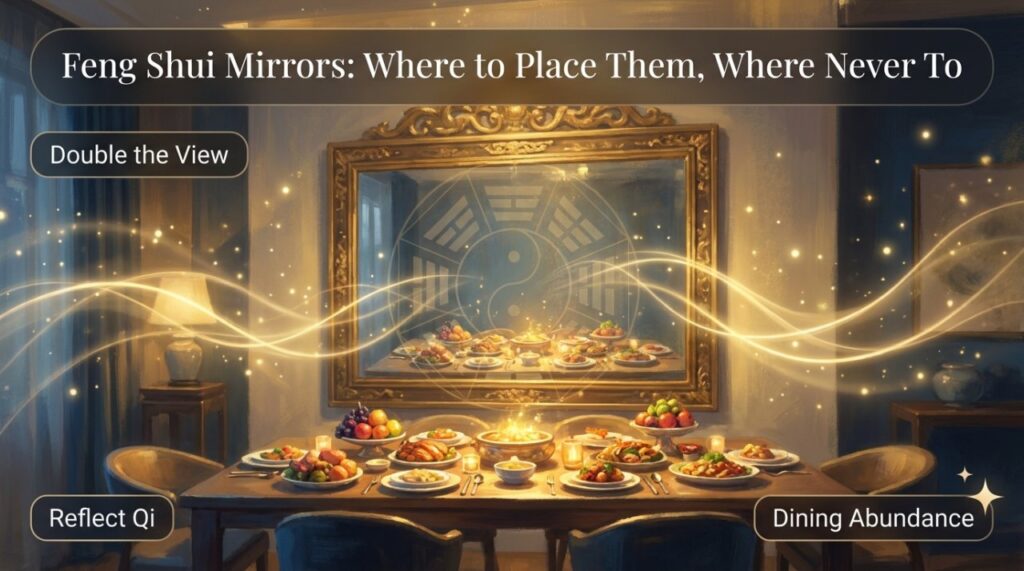
Mirrors are Feng Shui’s most-used and most-misused tool. Pinterest will tell you to “put a mirror in your wealth corner to double the money.” This is bad advice — and one of the few Feng Shui claims that all classical schools agree is wrong. Mirrors are powerful precisely because they redirect, double, or repel qi; place them carelessly and you compound problems rather than fix them. This guide covers what mirrors actually do, where they help, where they hurt, and the specific placement rules that survived four centuries of practice.
What mirrors actually do in Feng Shui
Three functions, in classical understanding:
- Reflect qi. A mirror sends incoming qi back where it came from. This is useful when qi is hostile (sharp corners, dangerous external sight lines) and harmful when qi is welcome (the front door’s incoming wealth, sunlight).
- Double a view. Whatever a mirror reflects effectively exists twice in the home’s energy. Reflecting a beautiful view doubles its benefit; reflecting clutter, a bathroom, or a bed doubles the problem.
- Expand a space. Mirrors visually open small rooms, making them feel larger and lighter. This is genuinely useful in cramped entryways and dark hallways — but the expansion is energetic too, so make sure what you’re “expanding” is positive.
Where mirrors help
Above a console table in the entryway
A clean mirror above the entry console — at roughly head height when standing — is one of the most universally beneficial Feng Shui placements. It:
- Visually expands a small entryway
- Reflects light from the doorway deeper into the home
- Lets occupants check their appearance before leaving (a small but real daily benefit)
Important: the mirror should not directly face the front door. It should be on a side wall in the entryway, not the wall opposite the front door. Why: a mirror opposite the door bounces incoming qi (including wealth qi) right back out the door before it can enter the home.
Reflecting a beautiful natural view
A mirror positioned to capture and reflect a garden, water feature, or vista doubles that beauty’s energetic contribution to the room. This works especially well in living rooms with one strong window view — mount the mirror on the opposite wall to “bring the view into the room.”
Behind the dining table
One of the few traditional “wealth doubling” placements that classical Feng Shui endorses. A mirror reflecting the dining table — and the food on it — symbolically doubles the household’s abundance. The dining mirror should be large enough to reflect the full table.
Across from a wealth-symbol object
A mirror reflecting a healthy plant, a piece of meaningful art, or a wealth-corner crystal doubles their energetic contribution. Specifically NOT a mirror in the wealth corner itself (see below) — but a mirror across the room from it, facing it.
To “see the door” in command position
If your desk or bed is in a position where you can’t see the door (back-to-door), a small mirror placed so you can see the reflected door restores the command position. This is the single most useful “remedy mirror” placement in residential Feng Shui.
To soften a beam
If you have an exposed ceiling beam over a bed, desk, or sofa, a small mirror affixed to the underside of the beam (facing down) symbolically “lifts” the beam’s compressive qi. This is a niche remedy but it works.
Where mirrors hurt — and what to do about them
Mirror facing the front door
The #1 mistake. A mirror on the wall directly opposite the front door bounces all incoming qi — including wealth, opportunity, and good news — straight back out the door. Even Pinterest articles say “use a mirror to make the entry feel bigger” without warning that direction matters.
Fix: move the mirror to a side wall (perpendicular to the door, not opposite). If you can’t move it, cover it with a curtain or piece of art that you can pull back when needed.
Mirror facing the bed
One of the most cited bad-Feng-Shui-bedroom rules. A mirror that reflects the sleeping body is considered to:
- Disturb sleep by adding subliminal “watching” energy
- Multiply the bed’s energy field in ways that disrupt the yin of sleep
- In relationship contexts, classically considered to invite “third parties” — a metaphor for relationship disturbance
Whether you accept the metaphysical claims or not, the practical effect is real: bedroom mirrors often startle people who wake at night and catch their own reflection. Most people sleep better when no mirror sees them.
Fix: if you have a closet with mirrored doors facing the bed, keep them closed at night. Hang a piece of cloth over a freestanding mirror that you don’t want to remove. Or move the mirror so it reflects something other than the bed (a beautiful piece of art on another wall, for instance).
Mirrors facing each other
Two mirrors directly facing each other create what classical Feng Shui calls “infinite reflection” — qi gets trapped bouncing between them rather than circulating in the room. This is exhausting energetically and produces a low-grade restlessness in occupants.
Fix: rotate one of the mirrors, or break the line of sight between them with a piece of furniture or a plant.
Mirror reflecting the bathroom or toilet
Any mirror that reflects the bathroom door (especially when open) or, worse, the toilet, doubles the room’s “drain” energy. The toilet symbolically pulls money down; doubling the visibility of that pulling action doubles the drain.
Fix: keep the bathroom door closed by default. If a mirror in another room reflects the bathroom door when open, reposition the mirror or use a sliding door for the bathroom.
Mirror in the wealth corner
The internet myth: “Put a mirror in your wealth corner to double your money.” The reality: a mirror in the wealth corner reflects the room’s outward face — which is usually clutter, the back of the sofa, or a wall. It also “splits” the gathering wealth energy rather than concentrating it.
Correct placement: a mirror on the opposite wall, reflecting the wealth corner. The wealth-symbol object (jade plant, crystal, art) stays in the corner; the mirror across the room doubles its visibility and effect.
Cracked, foggy, antique-distorted mirrors
Mirrors should reflect cleanly. Cracks, fog, age-spots, and distortions all project distorted qi back into the room. Cracked = throw out. Foggy = clean or replace. Antique-distorted (intentionally aged decorative mirrors) = use sparingly and only in low-stakes spaces (bathrooms, hallways), never in bedrooms or workspaces.
Mirror tiles (“disco” effect)
Walls of small mirror tiles fragment qi into chaos. Even one wall of tile mirrors in a living room or bedroom produces measurable restlessness in occupants. If you’ve inherited a tile-mirror wall, the best fix is covering it with art or curtains rather than removing it (removal often damages drywall).
The Ba Gua mirror — outdoor only
The octagonal mirror with eight trigrams around the border (called a Ba Gua mirror, 八卦镜) is a protective mirror, not a wealth-attracting one. It’s classically hung outside the front door — above it, facing outward — to repel sharp qi from external sources (a road pointing at your house, a sharp building corner, an electrical pole).
Three rules with Ba Gua mirrors:
- Outdoor use only. Inside the home, a Ba Gua mirror reflects negative qi at the occupants. This is the most common Feng Shui mistake foreigners make.
- Convex (凸) vs. concave (凹). Convex repels (most common). Concave absorbs (use only in specialist consultations).
- Don’t aim at neighbors. Pointing a Ba Gua mirror at a neighbor’s front door is considered an aggressive act in Feng Shui culture and can damage neighborhood relationships even from people who don’t practice Feng Shui themselves. Aim at the actual source of sharp qi (a road, a pole), not at people.
Mirror size and shape
Classical preferences:
- Round mirrors — most harmonious. Smooth qi flow, no sharp corners. Ideal for entries and living rooms.
- Square mirrors — stable, grounding. Good above console tables and in offices.
- Rectangular mirrors — neutral. Standard for above-sink bathroom and dressing-area mirrors.
- Octagonal Ba Gua mirrors — only outdoor use (see above).
- Irregular / asymmetric shapes — generally avoided in Feng Shui; the distortion of reflection works against the calming effect.
Size: a mirror should show the full head of the tallest occupant when used. Mirrors that cut off the top of someone’s head when they stand at normal viewing distance create subliminal “you don’t fully fit” anxiety — small effect per day, large effect across years.
Quick audit checklist
Walk through your home with this list:
- Mirror facing the front door — move or cover.
- Mirror facing the bed — move or curtain.
- Mirrors facing each other — rotate one.
- Mirror reflecting bathroom/toilet — close bathroom door by default.
- Mirror in the wealth corner — move it to the opposite wall instead.
- Any cracked or foggy mirrors — repair or remove.
- Ba Gua mirror indoors — move outside.
- Mirrors so high that they cut off the top of standing occupants’ heads — replace with taller mirrors or lower mounting.
Most homes have 1-2 of these issues. Fixing them is one of the highest-leverage afternoon Feng Shui projects you can do.
Frequently asked questions
Is it bad Feng Shui to have a mirror facing the bed?
Yes — classical Feng Shui considers a mirror reflecting the sleeping body to disturb sleep, multiply the bed’s energy field disruptively, and (in relationship contexts) symbolically invite third parties. If you have a mirrored closet facing the bed, keep the doors closed at night or cover the mirror with cloth.
Should I put a mirror facing my front door?
No. A mirror on the wall directly opposite the front door bounces incoming qi (including wealth and opportunity) right back out. Move it to a side wall in the entryway instead, perpendicular to the door not opposite it.
What’s the best place for a mirror in the entryway?
On a side wall in the entry, above a console table at roughly head height. This visually expands the space, reflects daylight deeper into the home, and lets occupants check appearance before leaving. Do NOT place it opposite the door.
Can a mirror really double my wealth?
The internet meme says “mirror in the wealth corner doubles money.” This is bad advice. A mirror IN the wealth corner reflects the rest of the room outward, splitting the gathering wealth energy. The correct placement is a mirror on the wall OPPOSITE the wealth corner, reflecting whatever wealth-symbol object (jade plant, crystal) sits in the corner.
What is a Ba Gua mirror and where should I use it?
The octagonal mirror with eight trigrams (Ba Gua mirror) is a protective tool, used OUTSIDE the front door above the lintel, facing outward to repel sharp qi from external sources. Never use it indoors — that reflects negative qi at occupants. Don’t aim at neighbors’ homes.
What shape mirror is best in Feng Shui?
Round mirrors are most harmonious (smooth qi flow). Square and rectangular are neutral. Avoid asymmetric, broken, or distorting mirrors. Reserve octagonal Ba Gua mirrors for outdoor protective use only.
Are mirrored closet doors a problem?
Mainly if they face the bed. Floor-to-ceiling mirrored closets are common in older homes and reflect the bed, which classical Feng Shui considers sleep-disturbing. Keep the doors closed at night, or replace with non-mirrored doors during your next renovation.
Next step
Pair your mirror audit with the rest of your room-by-room work: overlay the 9-palace grid on your home to find which palace each problem mirror sits in. A bad mirror in a critical wealth or relationship palace produces stronger negative effect than a bad mirror in a neutral palace.
FateFinder builds the calculators and reading tools that traditional Chinese Feng Shui masters use, in plain English and free to anyone. Our engines implement the same Shen-style Xuan Kong rules, Eight Mansions formulas, and Bazi calculations used in classical practice. Read our story →