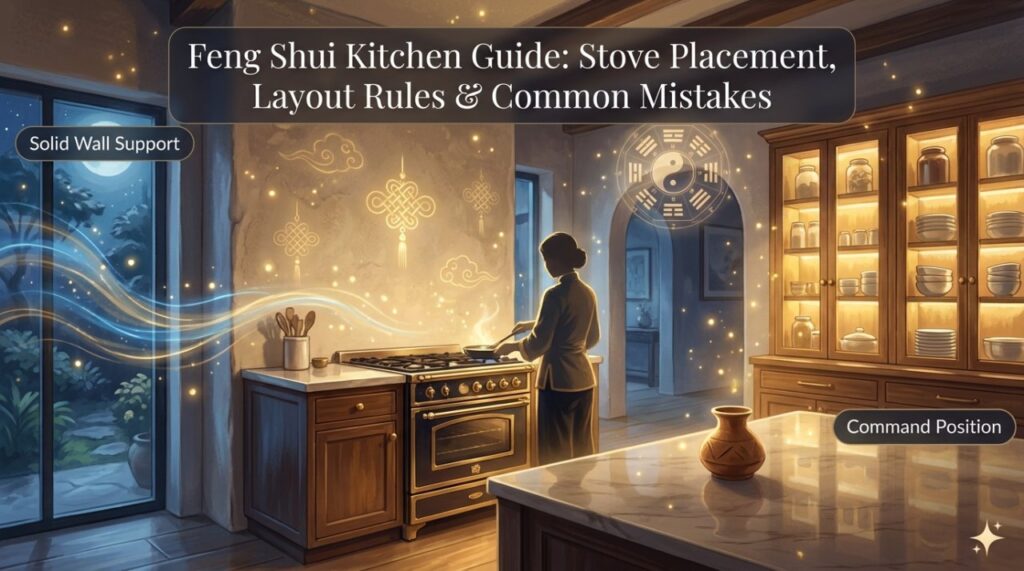
The kitchen is the third most important room in a Feng Shui home, after the front door and the bed. It controls two of life’s most basic streams — what nourishes you and what generates household wealth. Get the kitchen wrong, and no amount of crystal wind-chimes elsewhere will fix it. This guide walks through what classical Feng Shui actually says about stove placement, the fire-water clashes most modern kitchens accidentally create, and the small fixes that solve 80% of bad-kitchen problems without renovation.
Why the kitchen matters so much
In classical Chinese thinking the stove is the “fire mouth” (火口) of the household. Where the fire mouth sits, what direction it faces, and what surrounds it, all determine the family’s prosperity and health. There’s a classical saying: “Watch the kitchen, you see the household’s fortune.”
Three reasons:
- Fire is wealth-active in Period 9 (2024–2043). We just entered a 20-year period ruled by the 9 Purple Fire Star, which means kitchen energy carries more wealth weight than it did in the previous period.
- The kitchen produces what your body becomes. Daily exposure to a kitchen that’s energetically clean and well-organized literally feeds the household. Daily exposure to one that’s chaotic, dim, or unclean accumulates as low-grade health drain.
- The stove is the most expensive Feng Shui mistake to correct. You can move a bed in twenty minutes; moving a stove requires a contractor. Get this right when you set up, and you save yourself years of friction.
The four rules of stove placement
Across multiple classical schools, four principles consistently apply to where the stove should sit. In order of importance:
Rule 1: The stove backs onto a solid wall
The stove should sit against a structural wall — not an island, not a peninsula floating in the room, not a half-wall, and especially not a window. A solid wall behind the cook signals support, protection, and a settled “earth” element under the fire. The cook’s back should be supported the way your back is supported when you sit in a good chair.
Common mistake: kitchen islands with a cooktop. These are the dominant modern American kitchen design, and they violate Rule 1 by definition. The cook stands with no support behind them, the fire is exposed on all sides, and qi flows around the stove rather than gathering at it.
If you already have an island stove: add a pendant lamp directly above (compressing qi downward), and avoid eating directly facing the island while the stove is on. A small earth-element object (terracotta vase, ceramic bowl) on the island near the cooktop helps anchor.
Rule 2: The cook can see the door
This is called the command position. The person at the stove should be able to see the kitchen entrance without turning their back to it. When you’re cooking, you’re vulnerable — heat, sharp tools, attention focused inward. Being startled by someone entering behind you is a daily small stress that accumulates.
If your stove forces you to face away from the door, install a mirror or reflective surface on the wall above the stove. A polished metal range hood works perfectly — many modern hoods are already mirror-finished. This lets you see what’s behind you without redesigning the kitchen.
Rule 3: Fire does not touch water
The stove and the sink should not sit next to each other, and they should not face each other across a narrow gallery. In the Five Elements, fire and water destroy each other — putting them adjacent creates a chronic micro-clash that the household absorbs energetically.
How adjacent is too adjacent? Classical guidance: keep at least 60cm (about 2 feet) of solid counter between them, and place an earth-element object between if they’re closer than that. Earth mediates fire and water (water makes earth muddy; earth absorbs both). A small plant in a ceramic pot, a wooden cutting board, or a wood-handled knife block all serve this purpose.
The same rule applies to the refrigerator. Fridge counts as water. A fridge directly next to or facing the stove creates the same clash.
Rule 4: The stove does not face the front door
You should not be able to stand in the front door, look straight ahead, and see the stove burners. The fire mouth is energetically intimate; an exposed view of it from the public entry leaks household wealth.
If your kitchen is open-plan and the stove is visible from the entry, partial screening fixes this: a freestanding bookshelf, a screen, even a tall plant. The point is not to seal it off — only to prevent direct sight lines.
Best direction for the stove
Beyond the four placement rules, the direction the stove faces also matters. The classical guideline: the stove’s fire mouth should face one of the household head’s four lucky directions (from Eight Mansions), and ideally not face the head’s worst direction (Jue Ming 绝命).
“Direction the stove faces” means: stand at the stove with your back to the wall it’s against; whichever way you’re facing is the stove’s facing direction.
Best directions vary by Kua number:
- East Group (Kua 1, 3, 4, 9): ideal stove facing — N, S, E, or SE. Avoid W, NW, SW, NE.
- West Group (Kua 2, 6, 7, 8): ideal stove facing — W, NW, SW, or NE. Avoid N, S, E, SE.
For multi-occupant households, classical practice prioritizes the primary income earner’s directions. Modern compromise: if your partner’s Kua is in the opposite group, the stove direction matches whoever does more of the cooking (since they’re the one actually receiving the fire-mouth qi daily).
Kitchen layout: the working triangle
Modern kitchen design uses the work triangle — stove, sink, refrigerator forming a triangle each no farther than 3m apart. Feng Shui largely agrees with this, with two refinements:
- The three vertices should form a triangle, not a line. A linear arrangement (stove-sink-fridge on one wall) creates qi that races along the wall without circulating. Triangular flow lets qi pool.
- The triangle should not be crossed by traffic patterns. If people walking from the dining room to the patio cut through the cook’s working space, productive qi gets disrupted daily.
Kitchen colors
The kitchen is fire-dominant by function (stove). Adding strong fire colors (deep red, bright orange) intensifies what’s already strong, often into chaotic energy. Better choices:
- Earth tones — beige, cream, terracotta, soft yellow. Earth absorbs excess fire and stabilizes the room.
- Wood tones — natural wood cabinets, sage green, light olive. Wood feeds fire gently rather than overwhelming.
- White — works well, especially in small kitchens, as metal that controls fire’s wildness.
Avoid pure black kitchens (excess water clashing with the stove’s fire) and all-red kitchens (fire-on-fire overload).
Lighting and ventilation
The kitchen should be the brightest room in the home during cooking hours. Dim kitchens accumulate yin energy that competes with the fire of the stove. A combination of overhead general lighting plus task lighting (under-cabinet LEDs) is ideal.
Ventilation matters energetically as much as practically. Stale air and lingering cooking odors in a closed kitchen mean qi isn’t circulating. A working range hood, vented to outside, is one of the highest-leverage Feng Shui upgrades you can make to an older kitchen.
Kitchen clutter is a wealth leak
Because the kitchen is fire-active and wealth-correlated, clutter here drains money. Specifically:
- Expired food in the pantry or fridge. Dead food = dead qi. Toss anything past its date, especially in the wealth corner (typically southeast).
- Crowded counters. Surfaces piled with mail, gadgets, and “I’ll deal with this later” items block the fire mouth’s energy. Aim for at least 60% of your counter surface visible.
- Broken appliances. A broken microwave or non-working toaster sitting on the counter is a Feng Shui dead zone. Repair or remove.
- Dirty range hood and stovetop. Grease buildup directly on the fire mouth is the most concentrated form of bad kitchen Feng Shui.
10 most common kitchen Feng Shui mistakes
- Stove on an island with no wall behind it — modern aesthetic, classical anti-pattern.
- Stove facing the bathroom door — water clash, plus hygiene-energy mixing.
- Stove directly under a window — fire blown around by drafts; financial luck “blows away.”
- Refrigerator directly facing the stove — water-fire clash across the gallery.
- Sink and stove on the same counter touching — water-fire adjacent; no earth buffer.
- Knives stored visibly on a magnetic strip facing the cook — sharp qi aimed at the cook’s body.
- Kitchen visible from the front door — wealth leak.
- Refrigerator next to the stove — same clash as #4.
- Beam directly over the stove — compressive qi above the fire mouth.
- Dim kitchen with single overhead bulb — yin accumulation in a yang-required room.
Quick fixes that don’t require renovation
| Problem | Quick fix |
|---|---|
| Stove on island | Pendant light directly above + earth-element object near cooktop |
| Can’t see door from stove | Mirror or polished hood above stove |
| Sink right next to stove | Wooden cutting board or small ceramic plant between them |
| Fridge facing stove | Hang a small wooden item (cutting board) on the fridge door |
| Stove visible from front door | Tall plant or screen partially blocking sight line |
| Dim kitchen | Under-cabinet LED strip + brighter bulb in main fixture |
| Cluttered counters | 30-min counter clear-out; aim for 60% surface visible |
Frequently asked questions
Where is the best place to put the stove in Feng Shui?
The stove should sit against a solid wall (not an island), with the cook able to see the kitchen door without turning. The stove should face one of the household head’s four lucky directions per Eight Mansions, ideally not the worst (Jue Ming). It should not face the front door, the bathroom, or directly oppose the refrigerator or sink.
Is it bad Feng Shui to have the stove on a kitchen island?
Yes, by classical standards. The stove on an island violates the “solid wall behind the cook” rule and exposes the fire mouth on all sides, dispersing wealth qi. If you can’t change the layout, mitigate by adding a pendant light directly above the cooktop and a small earth-element object (ceramic, terracotta) near the burners to anchor the energy.
Can I have the stove next to the refrigerator?
It’s a Feng Shui no-no — refrigerator counts as water, stove as fire, and the two elements destroy each other. The minimum acceptable gap is about 60cm (2 feet) of solid counter. Closer than that, place an earth-element object between (ceramic, wood cutting board, plant in a clay pot) to mediate.
What color should a Feng Shui kitchen be?
Earth tones (beige, cream, terracotta, soft yellow), wood tones (natural wood, sage), and white all work well. Avoid all-red kitchens (fire overload with the stove) and all-black kitchens (water clashing with the stove). Greens and warm neutrals are the most universally safe choices.
What if my kitchen is in the wrong direction of the house?
For some houses, the kitchen sits in a Flying-Stars-unfavorable palace (e.g., where the 2 Black or 5 Yellow stars land). You can soften the impact by keeping the kitchen scrupulously clean, well-lit, and decluttered, and by avoiding heavy renovations during years when the 5 Yellow visits. Our Flying Stars Calculator will tell you which palace your kitchen sits in.
Should I be worried if my kitchen has a north-facing window?
Not unduly. North is water and the kitchen is fire-dominant; a north-facing window adds water energy that needs balancing. Make sure the stove is not directly under that window, and add wood-element accents (plants, wood cabinets) which mediate the fire-water tension.
What’s the best layout for a small Feng Shui kitchen?
For small kitchens, an L-shape or U-shape works best — both provide a solid wall behind the stove and create a natural work triangle. Galley kitchens (two parallel walls) are challenging because the stove on one wall often directly faces the sink/fridge on the other; if you have a galley layout, ensure those elements are offset rather than directly opposite.
Next step
Find which palace of the 9-palace grid your kitchen sits in using our Floor Plan Overlay tool. Then layer your personal directions to see whether your stove’s facing direction is favorable for the primary cook. Where the kitchen palace, your personal lucky direction, and a Period-9 auspicious star all line up — that’s the high-leverage corner for a small kitchen renovation if you’re considering one.
FateFinder builds the calculators and reading tools that traditional Chinese Feng Shui masters use, in plain English and free to anyone. Our engines implement the same Shen-style Xuan Kong rules, Eight Mansions formulas, and Bazi calculations used in classical practice. Read our story →