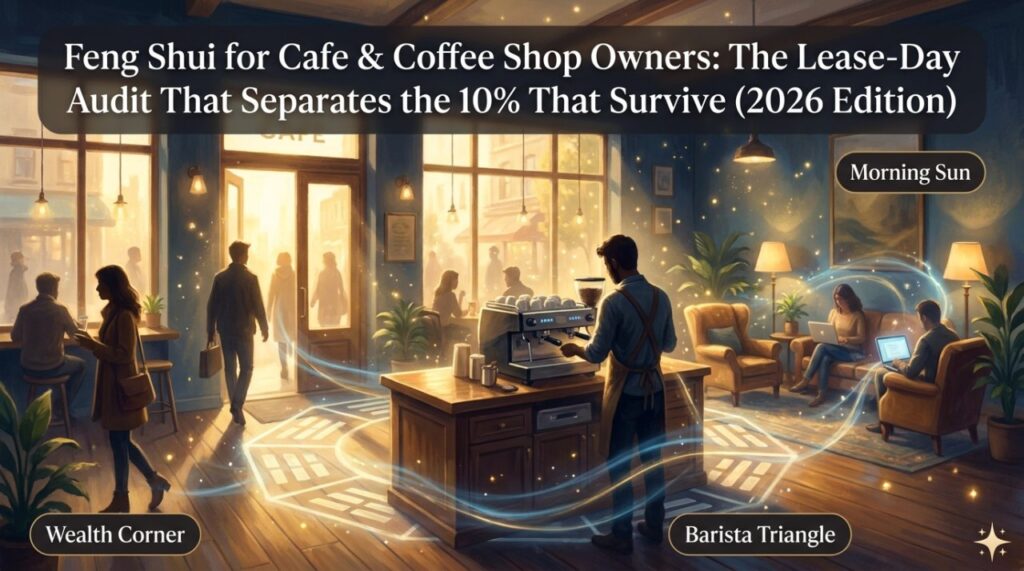
Independent coffee shops fail at 60% in year one and 90% by year five. Talk to any failed-cafe owner and the post-mortem almost always names rent, foot traffic, or “the neighborhood never showed up.” Two of those three are location problems — and location problems are feng shui problems, dressed up in real-estate language.
This is the pre-lease + post-open feng shui audit specifically for cafes. It’s narrower than the restaurant version — cafes have different dwell-time, different morning-vs-afternoon energy, and a different relationship between the barista, the customer, and the door.
1. Morning sun matters more than evening sun
Cafes are morning businesses. 60-75% of independent-cafe revenue lands before 1pm. That makes east and southeast-facing entrances the single highest-ROI feature you can find. Morning sun pours into the dining room exactly when your highest-margin customers (the regulars, the work-from-cafe crowd) are deciding where to settle in for two hours.
West-facing is the opposite trap. Brutal afternoon glare, sleepy energy in the morning. Many “great location” west-facing storefronts that read perfectly on a real-estate tour at 2pm look completely different at 7am — and 7am is when your business actually happens.
Quick screen: visit any finalist location between 6:45 and 8:30am on a Tuesday or Wednesday. Photograph the door from across the street. If it’s still in shadow, that’s a yellow flag for cafe specifically.
2. The barista-customer-door triangle
The single most important interior decision in a cafe is where the bar (espresso machine + register) sits relative to the front door. Three patterns work; one is fatal.
Works:
- Bar perpendicular to the door, on the left or right side. Customer walks in, the bar is in their peripheral vision, they orient naturally toward it. Barista sees every customer arrive.
- Bar at a 45° angle facing the door — even better. Welcoming energy. Most “Instagram cafes” use this layout.
- Bar at the back wall, facing the door — works only if the path from door to bar is unobstructed AND the back wall is solid (not a window).
Fatal pattern: Bar against a side wall with the barista’s back to the door. The barista can’t see arriving customers, customers feel ignored, the qi from the entrance hits the barista’s back (a classical “knife-in-back” sha for the operator). This single mistake is the highest-impact thing we see in failing cafes.
3. The dwell-time corner (where money quietly compounds)
Cafes make money two ways: (a) the quick-order morning rush, and (b) the laptop-camper afternoon. The afternoon is higher-margin per square foot than people think — a $5 latte that holds the seat for 90 minutes is great if the seat would otherwise be empty.
The wealth palace of the room — diagonal-far from the front door — should be the most comfortable seating area. Soft lighting, slightly warmer, wall outlets, a view of something (the street, a plant wall, the bar). This is where the regulars settle. It’s where word-of-mouth gets born.
What kills the dwell corner: facing a bathroom door, directly under a vent that drops cold air on the laptop crowd, a TV that pulls attention away from the cafe itself, a window with harsh western glare in the afternoon.
4. The pastry case and grab-and-go shelf
Pastry display in the customer’s first 4 feet of dwell time after they enter the door. Their eyes need to land on something delicious before they reach the register. Classical principle: place “wealth-activating goods” (high-margin add-ons) on the path of incoming qi.
The most common mistake: pastry case to the side or behind the customer at the register. The decision-to-buy window has already closed. Pastry attach rates in cafes with pre-register display run 35-50%. With at-register or behind-register display, 12-20%.
5. The bathroom (yes, again)
Same restaurant-feng-shui rule, with one cafe-specific twist: laptop campers will not tolerate a bad bathroom. If the bathroom is small, dark, or in an awkward path (cross the entire cafe past every table), the afternoon dwell-time customer simply chooses a different cafe within a 4-block radius. You lose them permanently and they never come back.
Bathroom that opens directly into the dining area, or that’s visible from the bar, or that’s in the wealth corner — these are all expensive problems. The cheapest cure is a heavy fabric partition + plants + low warm lighting. The most expensive (and most permanent) is to walk away from the lease.
6. The street-level adjacency check
Walk one block in each direction from the front door. Note every single business you pass. The pattern matters more than the absolute location:
- Adjacent to a bookstore, gym, yoga studio, co-working space → excellent. Your customers are already in the neighborhood for the right reasons.
- Adjacent to a dispensary, liquor store, bar with daytime hours → neutral-to-positive in the right city, but check the actual customer overlap.
- Adjacent to a funeral home, hospital, urgent care → yin-heavy energy. Workable but you’ll want stronger fire-element cures (warm lighting, copper, terracotta).
- Adjacent to a Starbucks → counterintuitively often positive for an independent. Starbucks does the customer-education work; you peel off the 20% who want better coffee.
- Adjacent to another independent cafe at the same price point → walk away unless your differentiation is obvious from the street.
7. The owner’s day master and the address
Cafes are fire-element businesses (heat, aroma, daily energetic peak). Owners whose day master is fire or earth tend to outperform identical concepts run by water-day-master owners in the same space. This isn’t deterministic — water-day-master owners can run great cafes — but they often need a partner whose element supplies the missing fire.
Find your day master via the free Bazi reading. Then run the address + your day master through the Commercial Address Pre-Lease Score ($29) before signing. The report flags element conflicts and gives the specific cures + brand-color recommendations + opening-date window that align with your chart.
The pre-lease cafe checklist (10 minutes)
- Visit at 7am Tuesday. Is the front in sun?
- Walk the path from door to bar. Where does the barista naturally stand? Are they facing arriving customers?
- Find the diagonal-far corner from the door. Is this the most comfortable spot you could create? Or is the bathroom there?
- Where will the pastry case go? Is it on the qi-line within 4 feet of the door?
- Walk one block north, south, east, west. Note adjacencies.
- Note what’s directly across the street. Anything sharp, dead, or aimed at the door?
- Sum the street number. 8 or 9 = strong. 2 or 5 = factor cure cost.
- Run the $29 audit. Get the technical 9-palace breakdown + your owner-Bazi alignment.
2026 specifics for cafe operators
- Year of the Horse (fire year) — strong tailwind for cafes generally. Visible warmth (exposed-bulb lighting, terracotta, copper, real wood) outperforms cold-industrial in 2026.
- Tai Sui in SOUTH — don’t put the espresso machine on the south wall in 2026. Don’t renovate the south side of the cafe in 2026.
- 3 Killings in NORTH — don’t move the front door from south to north in 2026.
- Best opening month range — March, April, August, October align well with most Bazi charts. June (Horse-month) is the worst — too much fire, energy spikes and burns out fast.
FAQ
I’m signing next week. What’s the minimum audit I should do?
The 10-minute pre-lease checklist above + the $29 Address report. Together: less than an hour of your time, less than the price of one supply order, informing a 5-year, six-figure commitment. There is no better cost-of-information arbitrage in the cafe-opening process.
I already signed a 5-year lease at a bad-feng-shui address. What now?
Priority order: (1) reposition the bar so the barista faces the door, (2) build the dwell corner in the far-diagonal of the room, (3) move the pastry case into the entry sight-line, (4) cure any bathroom-position problem with partition + plants + warm light. Most addresses recover 60-80% of their lost performance with these four interventions.
Does drive-through cafe feng shui follow these rules?
Partially. The dwell-corner rule doesn’t apply (no dwellers). The bar-customer-door triangle still does — the drive-through window IS the door. The order-board / payment-station alignment with the customer’s car becomes the equivalent of the bar-customer-door rule.
What about ghost-coffee / online-only?
Outside scope of this audit — but the kitchen / production-space rules from the restaurant audit still apply: owner-element alignment, wealth palace = roastery/equipment, bathroom not in wealth corner.
I’m in a strip mall. Are the rules different?
Slightly. Strip-mall storefronts can’t really change facing direction. The interior rules (bar position, dwell corner, pastry placement) become even more important since you’ve already accepted whatever the building gave you. The $29 audit specifically flags strip-mall layouts and gives strip-mall-optimized cures.
Bottom line: Coffee shops are time-of-day businesses, dwell-time businesses, and adjacency businesses simultaneously. All three are feng shui questions wearing real-estate clothes. The pre-lease audit costs less than your first $29 supply order. The lease costs five years of your life.
Run the Pre-Lease Audit ($29) →
Related: Feng Shui for Restaurant Owners · Feng Shui for Realtors · Feng Shui for Stock Traders
FateFinder builds the calculators and reading tools that traditional Chinese Feng Shui masters use, in plain English and free to anyone. Our engines implement the same Shen-style Xuan Kong rules, Eight Mansions formulas, and Bazi calculations used in classical practice. Read our story →