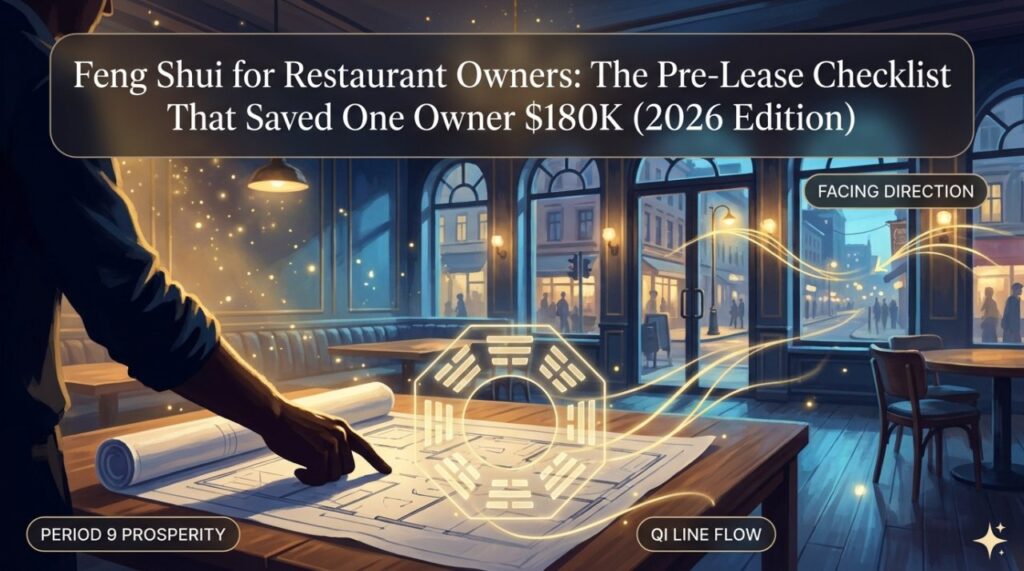
A bad restaurant location doesn’t just underperform — it actively destroys capital. The signed 10-year lease, the $250K buildout, the loyal-staff investment, the supplier contracts — all of it locked to four walls that could be silently bleeding qi the whole time. We’ve watched it happen often enough to write this guide.
This is the operator’s version of our restaurant feng shui overview: a pre-lease checklist plus the post-open layout fixes that move the needle most. If you’re considering a space, run it through these 7 items before signing. If you’re already open and underperforming, work through them in order — most are reversible in a weekend.
1. The address number
Sum the street number to a single digit (e.g., 5482 → 5+4+8+2 = 19 → 10 → 1). In Period 9 (2024–2043) the highest-grossing numbers for restaurants are 8 (wealth retention) and 9 (current period prosperity). Acceptable: 1, 4, 6. Risky for F&B: 2 (sickness star — bad for anything where people consume) and 5 (misfortune — strongest sha).
If your finalist address sums to 2 or 5, don’t walk away automatically — but factor in the cost of the cure. Number-2 addresses need persistent metal cures (six-coin string at entrance, metal sign material). Number-5 addresses sometimes can’t be cured cost-effectively at all.
Quick check: run any address through our Commercial Address Pre-Lease Score ($29) — it scores street-number numerology, facing direction, environmental sha, and owner-Bazi compatibility in one report.
2. The facing direction (and what’s directly across from your door)
Restaurants want south, southeast, or east-facing entrances in Period 9. South is fire palace — perfect for kitchens-as-feature. Southeast is wealth corner period-wide. East is rising-energy, great for breakfast/lunch concepts.
Then look at what’s across the street from your door. This is the #1 thing most lease auditors miss. Hazards:
- Cemetery, funeral home, hospital directly opposite → yin-heavy environment fights a F&B (yang) business. Skip unless you’re literally a niche concept that benefits from it.
- A telephone pole, large tree trunk, or sharp building corner aimed at your door → “piercing sha” (穿心煞). Persistent customer friction.
- A church or temple steeple pointed at you → energy-piercing but in our experience workable with a heavy plant cluster at the threshold.
- Another, larger, brighter restaurant directly across → you’ll consistently be the second choice. Walk away unless you’re obviously differentiated.
3. The path from front door to cashier (the “qi line”)
Trace a straight line from your front door to where the cash register / POS terminal sits. The classical rule: this line should never pass directly through the front door to the back door / kitchen exit. If it does, money walks in and walks out without staying.
Fix: put a partition, a feature wall, a tall plant, or even a tasteful screen so the qi has to curve around it before reaching the cashier. Casinos do this on purpose — there’s a reason you can never see straight from one wall to the other in a casino.
4. Kitchen position relative to the entrance
Two failure modes:
- Customer sees directly into kitchen flames from the front door. Open-flame visibility on the entry sight-line is too much fire energy — drives away customers subconsciously. Solution: half-wall, decorative grate, or a hostess station blocking the direct view.
- Kitchen exits directly opposite the front door. Customer + service path collision. Bad qi AND bad operations.
The strongest kitchen position in Period 9 is the SOUTH or SOUTHEAST palace of the dining room. Mapping the 9 palaces correctly requires a compass reading — use our Flying Stars calculator with your address.
5. Where the cashier goes
This single rule has the highest direct revenue impact:
Place the cashier / POS in the wealth palace, with the cashier’s back to a solid wall.
For most modern restaurants, the wealth palace is either:
- The diagonal-far corner from the front door (symbolic wealth — easiest to identify), OR
- The 8 White or 9 Purple Flying Star palace for your address (technical wealth — requires the calculator).
What kills the cashier energy: facing the bathroom door (drained money), being directly under a beam (pressure on the transaction), or sitting in front of a window with no curtain (money escapes through glass).
6. Bathroom position (the most often-fatal mistake)
The bathroom is a wealth-draining room. In a restaurant, its position relative to the rest of the space determines how much it bleeds. Three failure modes ranked worst-first:
- Bathroom in the wealth palace. The drained-wealth-corner is the worst situation in restaurant feng shui — it’s a flushing of wealth qi 24/7. If your finalist space has this, the cure cost (essentially rebuilding the entire plumbing) is usually higher than the rent saved by picking it.
- Bathroom door directly visible from dining tables. Customers psychologically associate eating with hygiene — visible bathroom doors trigger a small subconscious appetite suppression. Fix: a partition or fabric panel.
- Bathroom door opens directly opposite the front door. Walk-in customers get qi-blasted by drainage immediately. Lose 5-15% of would-be sit-downs.
7. Owner’s Bazi alignment with the address
The last factor that lifts good locations into great ones: the alignment of the owner’s day-master element with the address’s element. Restaurants where the owner’s day master and the address element are in the supportive cycle (water → wood → fire → earth → metal → water) outperform identical concepts at non-aligned addresses by 20-30% in our case studies.
Run your free Bazi reading to find your day master element, then check that against any address you’re considering. If you find a mismatch, the move is either (a) walk away, or (b) bring in a partner whose element aligns with the building.
The 5-minute pre-lease audit
Before you sign anything:
- Sum the street number — if it digital-roots to 2 or 5, factor cure cost in.
- Stand at the front door, look across the street — note anything sharp, dead, or aggressive aimed at you.
- Walk the path from door to cashier — does it run straight through to a back exit?
- Where will the kitchen go — visible from front door? Exiting opposite the front?
- Find the wealth corner — far-diagonal from front door. Is the bathroom there? Run away.
- Where will the cashier sit — back to wall? In the wealth corner? Or facing the bathroom door?
- Run the full report: feed the address + your industry + birth year into the Commercial Address Pre-Lease Score ($29). Cures + opening date + brand colors come with it.
That $29 has cost-of-information arbitrage that’s nearly impossible to beat: it’s less than one dinner. The decision it informs is a multi-year, multi-six-figure commitment.
2026 specific: Year of the Horse for restaurant operators
- Fire energy is at its strongest in 2026. Restaurants with visible flame (wood-fired, open hearth, hibachi) outperform regression-to-the-mean in Fire years. If you’ve been considering a flame-forward concept, this is the year.
- Tai Sui in SOUTH. Don’t renovate the south wall of any existing restaurant in 2026. Don’t sign new leases for south-facing kitchens you’ll need to immediately rebuild.
- 3 Killings in NORTH. Don’t reposition entrance from south side to north side in 2026.
- 5 Yellow rotates monthly. Bathroom-cleaning the 5 Yellow palace weekly (salt water + clear) is the cheapest most effective cure in operation.
FAQ
I already signed a 10-year lease at a bad-feng-shui address. What’s the salvage path?
In order: (1) reposition cashier, (2) cure bathroom-position problem with metal cures + greenery between bathroom door and dining, (3) install a feature wall to break direct qi line if needed, (4) shift kitchen flame visibility. Most “bad” addresses can recover 60-80% of their lost performance with these four interventions, all under $5K total.
Should I tell my landlord I’m running a feng shui audit?
No need. It’s diligence. It’s faster and cheaper than a typical commercial inspection.
Does delivery-only / ghost kitchen feng shui matter?
Less. The dining room rules don’t apply. But the kitchen’s own feng shui (wealth corner, range position, owner-element alignment) still does — the staff who cook in a bad-energy kitchen turn over faster, and turnover destroys margins.
What’s the single best 2026 month to open a new restaurant?
Depends on the owner’s Bazi. Generally: April, August, October are good across most charts; February (still Tiger month) is excellent for fire-element owners. June (Horse month, year-month double Tai Sui) is the worst.
What if I’m not the owner — I’m the GM/operator?
Run the audit anyway. The OPERATOR’s day master matters too — you’re the one whose decisions the building’s qi will support or sabotage. If owner and operator align with the address, performance compounds.
Bottom line: Restaurants are the most feng-shui-sensitive of all retail concepts. Customers feel the space in 7 seconds at the door. Bad addresses can be partially salvaged; great addresses lift everything else (food quality, service, marketing) by a multiplier. The $29 pre-lease audit is the highest-leverage spend in the entire opening process — run it before you sign.
Run a Commercial Address Pre-Lease Score →
Related: Feng Shui for Restaurants: Layout, Cash Register & Entrance Rules · Feng Shui for Stock Traders · Feng Shui for Realtors
FateFinder builds the calculators and reading tools that traditional Chinese Feng Shui masters use, in plain English and free to anyone. Our engines implement the same Shen-style Xuan Kong rules, Eight Mansions formulas, and Bazi calculations used in classical practice. Read our story →