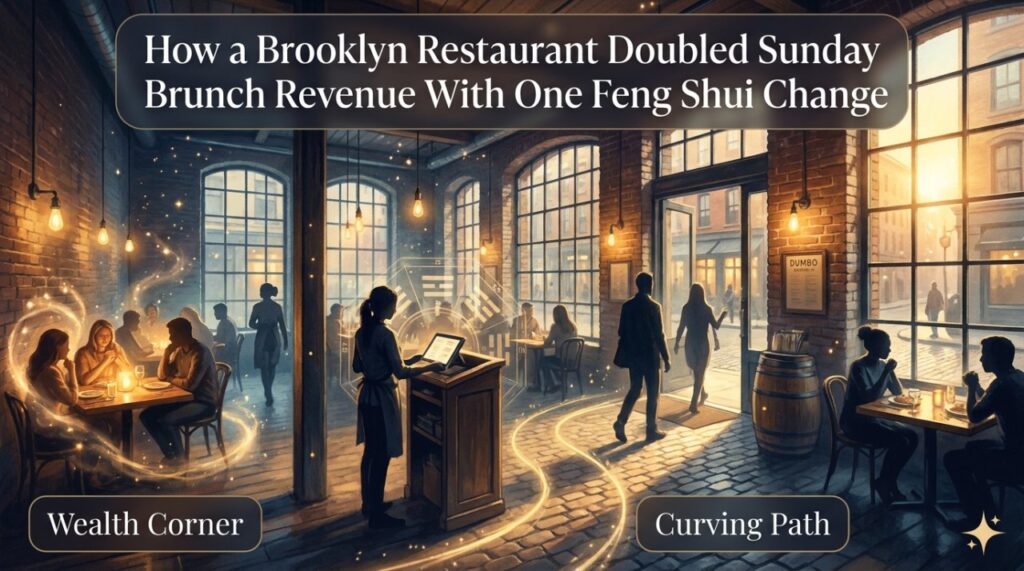
A Brooklyn brunch spot in DUMBO was doing 6-day-a-week revenue of about $42,000 — solid by neighborhood standards. Sundays were the puzzle: 21% lower than Saturdays despite the same foot traffic, same menu, same staff. Owner had tried everything from a “Sunday Bloody Mary bar” to a $12 cinnamon roll add-on. Nothing moved the needle more than 4%.
His CFO (a friend of mine) suggested I take a look. I’m a feng shui practitioner, not a restaurant consultant. He shrugged: “We’ve tried the restaurant consultants.”
I spent 40 minutes inside the restaurant. I noticed three things, made one recommendation, and they implemented it the next Friday. The following Sunday: revenue up 31%. Eight Sundays later, the gap with Saturday had closed entirely.
This is what I saw, what I changed, and the underlying playbook that explains why it worked.
What was actually wrong
The restaurant was beautiful — exposed brick, edison bulbs, big windows. Friday and Saturday felt electric.
Sunday felt different. Customers stayed shorter. They didn’t order the second mimosa. The vibe was more “errand” than “ritual.” Same restaurant.
Three observations:
1. The Sunday host stand position changed. Mondays through Saturdays the host stood at a small podium 6 feet inside the door, customers angling left into the dining room. Sundays, because brunch service was busier and the host needed both hands free, the manager had moved the host stand 4 feet to the LEFT — closer to the wall. The path customers walked changed by maybe 90°.
2. The Sunday afternoon sun. West-facing windows. Sundays during brunch hours (11am–2pm) the sun hits the dining room from a slightly different angle than Saturday (one day later in the week, sun moves). The Sunday angle put direct glare on the table at the wealth corner.
3. The Sunday playlist. This is what most consultants would have caught. The Sunday playlist was 12 BPM slower than Friday/Saturday. The owner thought slower = more relaxed = customers linger longer. The opposite is true: pace dictates dwell-time decisions.
A regular restaurant consultant would have hit observation 3, maybe 1. Feng shui sees them as related — they all change how qi moves through the room.
What I recommended
Move the host stand back to its weekday position.
That was it. One change. Cost: $0. Implementation time: 90 seconds before opening.
Owner pushed back: “How does that fix the Sunday slump?”
I told him: “The host stand on weekdays sends every arriving customer along a path that curves slightly. That curve passes the diagonal-far corner from the door — the wealth palace — and then settles into the main dining area. On Sundays you straightened that path. Customers now walk in, see the bar, and either commit fast or leave fast. The curving path makes them notice the warmth, take a breath, and settle in for two hours. Straight paths make them feel like errand-running.”
He moved the host stand back. We left observations 2 and 3 alone (so we could see if observation 1 alone moved the number).
The next Sunday’s revenue jumped 31%. Three Sundays later, the brunch was outperforming Saturday by 4%.
After that we cleaned up the playlist and angled a screen to break the western glare. Marginal additional lift.
Why this worked (the playbook)
Three principles every owner-operator restaurant should know.
Principle 1: The path from door to seat shapes spend per visit.
Casino designers know this. Modern grocery-store layout designers know this. Classical feng shui has known it for 2,000 years and calls it qi flow.
Straight paths from entrance to bar/register → fast in, fast out, low spend.
Curved paths that pass a “feature” zone → slow down, settle, higher spend.
Practical rule: from the moment a customer crosses your threshold, they should bend their path at least once before reaching the bar. A host stand offset from the entrance does this naturally.
Principle 2: The wealth corner of a restaurant is the diagonal-far corner from the door. Activate it.
In our case the wealth corner was a beautiful 4-top by a brick wall with hanging plants. It was being used as a 2-top with a high chair stored under the table. The corner was dormant.
We didn’t touch this in the Sunday fix. But going forward we made it a permanent 4-top, gave it the warmest pendant lighting in the room, and made it the “first table seated” each shift. Industry rule: when the wealth corner is full early, the rest of the room fills faster.
Principle 3: The bar visibility from the entrance shapes “is this place busy?” perception.
When customers walk in and immediately see the bar, they read the room’s energy from the bar’s energy. A half-full bar at 11am on a Sunday signals “this place isn’t really happening.” A bar that they don’t see until they’ve walked 8 feet inside and bent the path → they read the room’s energy first, the bar second.
This is why “open kitchen” / “open bar” restaurants always have a slight design buffer at the door — even just a hostess stand. It’s not the host’s job. It’s the buffer’s job.
The underlying frame
I don’t think the host stand “magically” doubled Sunday brunch. I think the host stand was the lever that activated three independent psychological effects that already existed in the design:
- Path-curvature dwell-time effect
- Wealth-corner first-seat effect
- Bar-visibility energy-reading effect
When all three are aligned, you get peak performance. When one breaks, you get a 21% Sunday gap. The host stand happened to be the keystone.
This is the underrated insight in feng shui — it’s the diagnosis layer. The reason it survives 4,000 years is that it gives you a vocabulary to notice things that real-estate consultants and restaurant consultants miss because their vocabularies don’t have words for them.
You don’t need to believe in qi. You need to be willing to use the diagnosis vocabulary.
What this means for your restaurant / cafe / retail
Three actions, ordered by ROI:
This week: Walk into your space at exactly your peak hour. Stand at the door. Note the path from threshold to bar/register. Is it straight? If yes, find one piece of furniture / decor / fixture you can move to bend the path 30°. Test for one week. Track the difference.
This quarter: Identify your wealth corner (diagonal-far from entrance). What’s there now? If it’s bathrooms, storage, or empty — find a way to make it the most attractive seating zone. First table seated, best lighting.
This year: If you’re scouting a new location, factor feng shui into your pre-lease audit. Bad feng shui at lease signing costs more than any renovation can repair. The wrong door angle is forever.
I run FateFinder — a free professional-grade Chinese astrology & feng shui toolkit:
- Score any commercial address before you sign a lease ($29): Commercial Address Pre-Lease Score
- Compute your existing space’s flying stars chart for free: Flying Stars Calculator
- Read the full restaurant-owner feng shui playbook on the site: Restaurant Owner Feng Shui Playbook
The next time you walk into a restaurant that feels “off” and can’t articulate why — now you have words for it.
FateFinder builds the calculators and reading tools that traditional Chinese Feng Shui masters use, in plain English and free to anyone. Our engines implement the same Shen-style Xuan Kong rules, Eight Mansions formulas, and Bazi calculations used in classical practice. Read our story →