 Lucky Direction? A Beginner's Guide to Eight Mansions Feng Shui" loading="eager" srcset="https://fatefinder.org/wp-content/uploads/ff-ai/2110-what-is-your-lucky-direction-a-beginners-guide-to-eight-mansions-feng-shui-1024x571.jpg 1024w, https://fatefinder.org/wp-content/uploads/ff-ai/2110-what-is-your-lucky-direction-a-beginners-guide-to-eight-mansions-feng-shui-300x167.jpg 300w, https://fatefinder.org/wp-content/uploads/ff-ai/2110-what-is-your-lucky-direction-a-beginners-guide-to-eight-mansions-feng-shui-768x428.jpg 768w, https://fatefinder.org/wp-content/uploads/ff-ai/2110-what-is-your-lucky-direction-a-beginners-guide-to-eight-mansions-feng-shui-50x28.jpg 50w, https://fatefinder.org/wp-content/uploads/ff-ai/2110-what-is-your-lucky-direction-a-beginners-guide-to-eight-mansions-feng-shui-100x56.jpg 100w, https://fatefinder.org/wp-content/uploads/ff-ai/2110-what-is-your-lucky-direction-a-beginners-guide-to-eight-mansions-feng-shui-600x335.jpg 600w, https://fatefinder.org/wp-content/uploads/ff-ai/2110-what-is-your-lucky-direction-a-beginners-guide-to-eight-mansions-feng-shui.jpg 1280w" sizes="(max-width: 1024px) 100vw, 1024px" decoding="async" title="What Is Your Lucky Direction? A Beginner's Guide to Eight Mansions Feng Shui">
Have you ever walked into a room and just felt off? Or settled into a new desk and watched your focus mysteriously sharpen? That’s not coincidence — that’s direction.
In Chinese Feng Shui, your personal lucky directions are determined the day you’re born, and they shape how you experience every space you inhabit. Get them right, and your bed becomes a deep-sleep retreat, your desk a productivity engine, your front door a magnet for opportunity. Get them wrong, and you spend years wondering why you keep losing money in a “perfect” house.
In the next 60 seconds, you’ll know yours.
The free calculator below uses Eight Mansions Feng Shui (八宅, Ba Zhai) — the same 3,000-year-old system used by traditional Chinese masters and modern practitioners like Lillian Too and Joey Yap. Enter your birth year and gender, and we’ll instantly show you:
- Your four lucky directions (for your bed, desk, front door)
- Your four unlucky directions (to avoid for major spaces)
- Whether you’re East Group or West Group
- Specific room-by-room setup recommendations
Find Your Personal Lucky Directions
Based on the 3,000-year-old Chinese system used by master Feng Shui practitioners, your birth year + gender reveal four directions that energize you — and four to avoid.
What Is Eight Mansions Feng Shui?
Eight Mansions is one of the two most important Feng Shui systems used by classical Chinese masters — the other being Flying Stars (玄空飞星, Xuan Kong). The two systems answer different questions:
- Flying Stars tells you about your house itself — its wealth corners, conflict zones, and rooms you shouldn’t renovate.
- Eight Mansions tells you about you personally — which directions energize you and which drain you.
The Eight Mansions system runs on a beautifully simple premise. Every person belongs to one of eight Life Guas (trigrams), determined by birth year and gender. Each Life Gua has four directions that energize them and four that drain them. That’s it. No expensive consultation, no years of training. Just your birthday + your home’s compass orientation.
The Chinese have used this exact method since at least the Tang Dynasty (7th century CE), and it remains a cornerstone of Hong Kong, Taiwanese, and mainland Chinese Feng Shui practice today.
Understanding Your Eight Personal Directions
Once you know your Life Gua (the calculator above figures it out for you), every compass direction takes on a specific meaning for you. Here’s what each one does:
Your Four Lucky Directions ✦
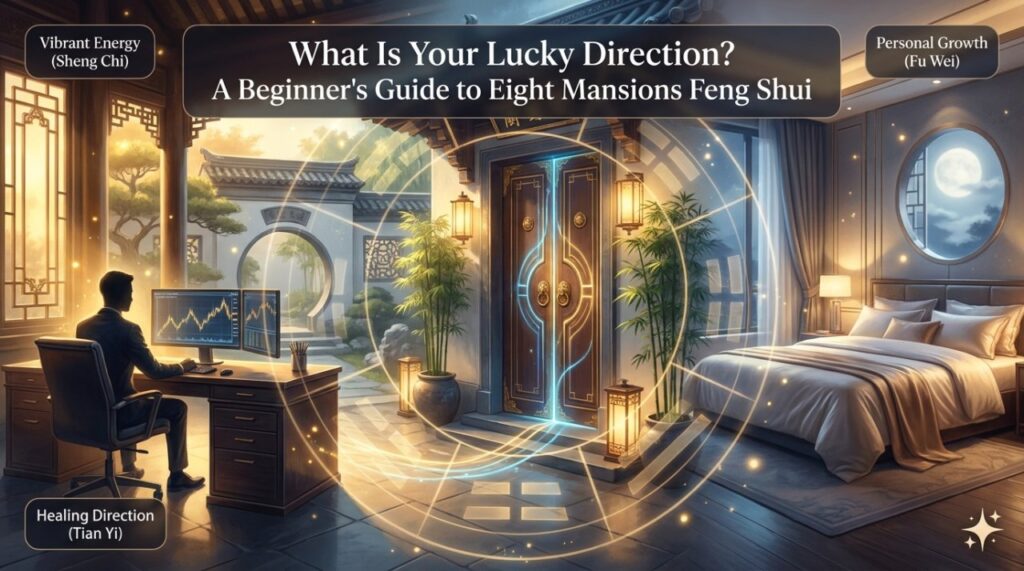
✦ Sheng Chi (生气) — “Vibrant Energy”
Your best direction. Brings success, opportunities, prosperity, vitality. Activate this corner with your front door, your office desk facing this way, or your wealth corner.
✚ Tian Yi (天医) — “Heavenly Doctor”
Your healing direction. Excellent for sleep and recovery. Position your bed so your head points this way for deep, restorative sleep. Many of our users notice better sleep within a week of adjusting their bed orientation alone.
♥ Yan Nian (延年) — “Longevity”
Your relationship direction. Strengthens marriage, friendships, and long-term partnerships. Perfect for the master bedroom of a couple, or the dining area where harmony matters.
☯ Fu Wei (伏位) — “Personal Growth”
Your stability direction. Grounds your personal energy. Use it for your study, meditation space, or any place you need steady, focused progress.
Your Four Unlucky Directions ✕
✕ Huo Hai (祸害) — “Mild Misfortune”
The mildest of the four bad directions. Brings minor setbacks, gossip, and legal annoyances. OK for storage, laundry room, or guest bathroom.
✕ Liu Sha (六煞) — “Six Killings”
Brings relationship conflict, lawsuits, and romantic complications. Avoid for kitchen and bedroom; fine for storage and pantry.
✕✕ Wu Gui (五鬼) — “Five Ghosts”
Severe negative energy — theft, betrayal, accidents. Counterintuitively, a bathroom here actually helps by “flushing” the bad qi.
✕✕✕ Jue Ming (绝命) — “Total Loss”
Your worst direction. Severe misfortune, health crises, financial loss. Never place your bedroom, front door, or stove here. Bathroom and garage work perfectly.
East Group vs. West Group: What’s the Difference?
Once you know your Life Gua number, you’ll fall into one of two groups:
| East Group (东四命) | West Group (西四命) |
|---|---|
| Life Guas: 1 Kan, 3 Zhen, 4 Xun, 9 Li | Life Guas: 2 Kun, 6 Qian, 7 Dui, 8 Gen |
| Best directions: N, E, SE, S | Best directions: NE, NW, SW, W |
| Avoid: NE, NW, SW, W | Avoid: N, E, SE, S |
What’s striking: each group’s “best four” are the other group’s “worst four.” The universe has a sense of dramatic irony.
This becomes important when buying a home or choosing a master bedroom for a couple. A house that strongly favors East Group members might create subtle friction for a West Group spouse. Traditional masters recommend that the head of household (usually the main earner) take precedence — the family then arranges individual rooms to match each person’s gua.
How to Use Your Lucky Directions Every Day
Now that you know your four auspicious directions, here’s how to actually use them in everyday life:
1. Your Front Door
If possible, your home’s front door should open from your Sheng Chi direction. This invites prosperity energy directly into your life. If your door doesn’t match, don’t panic — you can compensate by activating other key areas inside.
2. Your Bed
You spend 8+ hours a day in bed, in a vulnerable state. Place it so your head points toward Tian Yi (your Heavenly Doctor direction). This single adjustment is the most impactful change you can make.
3. Your Desk
When seated, face your Sheng Chi direction. This is the direction you “look toward” while working — not the direction your back faces. Practiced consistently, it sharpens focus, decision-making, and career luck over months.
4. Your Kitchen Stove
The “fire mouth” of your stove (where flames or burners are) should ideally face your Tian Yi direction — symbolically feeding the family’s health through the cooking process.
5. Your Bathroom (the surprising one)
Place a bathroom on your worst direction (Jue Ming) if possible. The drainage symbolically “flushes” the negative energy of that direction. This is one of the few areas where a bad direction is actually helpful.
Common Mistakes Even Experienced Practitioners Make
Mistake 1: Using the wrong birth year
If you were born before February 4th or 5th, the Chinese lunar new year hadn’t started yet. Use the previous Gregorian year for your calculation. Our calculator follows standard Western convention; just be mindful of this if you hand-calculate.
Mistake 2: Ignoring direction in rentals
“I can’t move my walls!” — true, but you can still align your bed, desk, and stove. Even in a 400-square-foot studio, simply choosing which way to face when working creates a noticeable difference within a month.
Mistake 3: Treating your worst direction as a curse
Your worst direction is only worst for primary functions like sleeping or your front door. For bathrooms, storage closets, and garages, it’s actually useful. Don’t fear it — use it strategically.
Mistake 4: Trying to optimize everything at once
You don’t need to remodel your house. Start with one change — usually the bed direction — and notice how you feel after two weeks. Add more adjustments only as you confirm the effect.
FAQ
Is Eight Mansions the same as my Kua number?
Yes. “Kua number” is the Western shorthand for what Chinese practitioners call your Life Gua. Same concept, same calculation, different vocabulary.
Can my Life Gua change as I age?
No. Your Life Gua is fixed at birth and stays with you for life — like your astrological sun sign.
What if I don’t know which direction my room faces?
Use any compass app on your phone. Stand in the center of the room and check which direction your bed’s headboard points to (for sleep) or which way you face when seated at your desk.
Should the whole family use the head of household’s gua?
The home’s main orientation (front door, kitchen) ideally favors the head of household. But each family member can — and should — arrange their own bedroom to favor their own gua.
Do I need an actual luopan (Chinese compass)?
No. A regular compass or smartphone compass app is sufficient for Eight Mansions. A traditional luopan becomes useful for more advanced Flying Stars analysis.
Going Deeper: Pair with Flying Stars
Eight Mansions gives you your personal direction map. To get the complete Feng Shui picture, pair it with Flying Stars — the system that analyzes your house itself based on when it was built and which way it faces.
Together they answer two complementary questions:
- Eight Mansions: “Which directions energize me?”
- Flying Stars: “Which corners of this house are auspicious right now?”
When both align — when your personal lucky direction matches the house’s auspicious corner — you’ve found a true power spot. That’s where master practitioners want you to put your bed, your desk, or your wealth corner.
→ Try the free Flying Stars Calculator
Feng Shui isn’t magic — it’s accumulated observation about how environment shapes experience. The fact that this system has survived 3,000 years and crossed multiple cultures suggests there’s something to the patterns. Use what works for you, discard what doesn’t, and notice the difference.
Related Reading
FateFinder builds the calculators and reading tools that traditional Chinese Feng Shui masters use, in plain English and free to anyone. Our engines implement the same Shen-style Xuan Kong rules, Eight Mansions formulas, and Bazi calculations used in classical practice. Read our story →