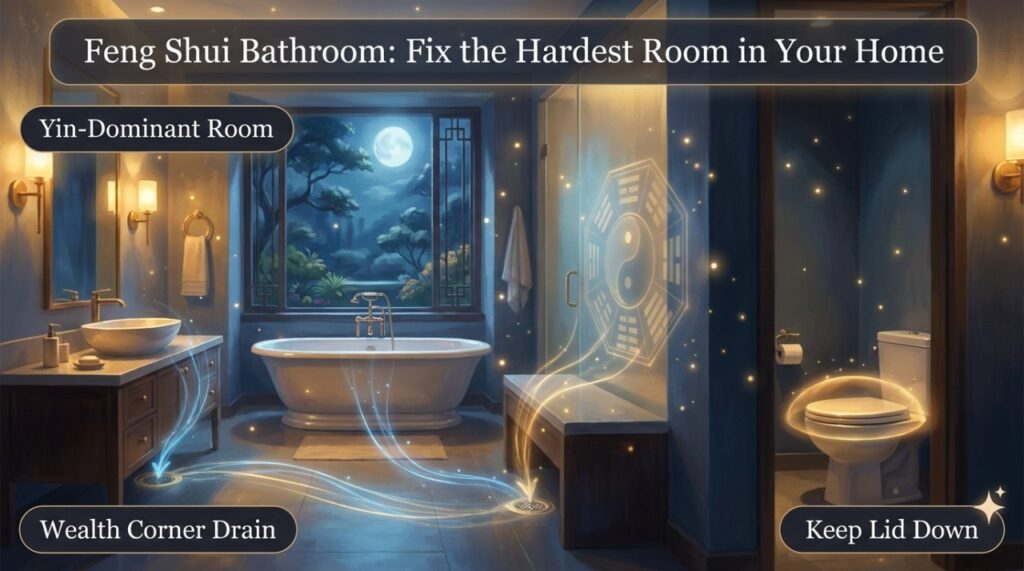
The bathroom is the hardest room in any home’s Feng Shui. Toilets, sinks, and drains literally pull water — and water carries wealth qi — downward and out. A bathroom in the wrong palace of your home can quietly drain household prosperity for years before anyone connects the dots. The good news: classical Feng Shui has 1,500 years of accumulated wisdom on neutralizing bathroom problems, and most of it requires no renovation. This guide is the complete practical version: where bathrooms hurt most, the four small habits that fix 80% of the damage, and the one bathroom position that’s actually good.
Why bathrooms are Feng Shui-hard
Three mechanisms:
- Water drains pull qi downward. The toilet, sink, shower, and bathtub all have drains that pull water — and energetically, qi — down and out of the home. Wealth qi follows water in Feng Shui theory. A heavy-drain room is a continuous low-grade energetic leak.
- The room itself is yin-dominant. Bathrooms are damp, often dim, frequently the smallest room in the house. They naturally accumulate yin (passive, cool, still) energy, which can leak into adjacent rooms if not contained.
- Toilets specifically. The toilet is the most aggressive drain in any home — it actively pulls. Where it sits in your home’s 9-palace grid matters more than any other single fixture’s location.
The worst bathroom positions
If you’re house-shopping, this section is decisive. If you already live somewhere, jump to the fixes section.
Bathroom in the wealth corner
If the toilet sits in the same palace as your home’s 8 White Wealth Star (Xuan Kong) or the southeast corner (BTB), the bathroom literally flushes wealth daily. This is the #1 Feng Shui house-buying red flag.
Bathroom in the center of the home
The center palace (中宫) is the “heart” of the home in classical Feng Shui. A bathroom here drains the household’s core energy. Less common in apartments, very common in mid-century US homes with interior windowless bathrooms.
Bathroom directly above the front door
On a second story, a bathroom directly above the front door means waste-water flows down past the home’s qi-mouth daily. Bad for incoming wealth qi.
Bathroom directly opposite the front door
You walk in, you see straight into the toilet. Incoming qi gets a direct view of the drain and reverses course. Common in narrow apartments.
Bathroom in the bedroom
Master en-suites are the dominant modern American design — and Feng Shui’s most controversial room. The en-suite’s drain in proximity to the bed disturbs sleep, and the moisture/odor flow into bedroom is a subtle but real qi-mixer.
The four fixes that solve 80% of bathroom problems
These work regardless of where the bathroom sits. They take minutes and cost nothing.
1. Keep the toilet lid down by default
The single most-cited Feng Shui rule, and it’s correct. An open toilet bowl is an exposed drain projecting “pulling” energy continuously. Lid down = drain symbolically capped.
Train every household member. Put a small sign on the inside of the lid if needed. This is the highest-leverage daily habit you can establish for your home’s wealth qi.
2. Keep the bathroom door closed by default
The bathroom door is the qi boundary between the drain-active room and the rest of the home. An always-open door means the bathroom’s pulling energy reaches into adjacent rooms continuously. Closed door contains it.
This rule applies especially strongly if the bathroom faces a bedroom, living room, kitchen, or the front door directly.
3. Fix all leaks immediately
A dripping faucet, a running toilet, a slow drain — each is a continuous, audible qi leak. Even small leaks accumulate. Feng Shui practitioners consider plumbing leaks the most expensive maintenance issue in any home to ignore.
4. Add a healthy plant
One plant in the bathroom is one of the few unambiguously beneficial Feng Shui additions. Plants:
- Absorb the room’s yin moisture into living growth
- Provide upward wood energy that counters the downward drain energy
- Improve air quality in a room that often lacks ventilation
Best species for bathrooms: peace lily, Boston fern, pothos, spider plant. All tolerate humidity and lower light. A single 30-40cm plant on the counter or window ledge is sufficient.
Mid-level fixes (still no renovation)
Mirror on the bathroom door — outside
A small full-length mirror on the outside of the bathroom door (the side facing the hallway, not inside the bathroom) symbolically “removes” the bathroom from the floor plan — qi reading the hallway encounters a mirrored panel rather than registering a bathroom there. This is a classical remedy for bathrooms in particularly bad palaces.
Important: not inside the bathroom, and not facing the bed if the door faces the bedroom. Outside only, hallway side.
Bright lighting and good ventilation
Yin rooms are improved by adding yang energy. Bathroom lighting should be substantially brighter than a typical bathroom — multiple light sources, warm white bulbs, no single-bulb-on-the-ceiling setups. Vent fans should actually run during and after showers (most don’t).
Earth tones and warm colors
Bathrooms are water-dominant by function. Adding warm tones (peach, beige, soft yellow, warm white) balances. Avoid all-black, all-grey, or all-blue bathrooms — these intensify water without balance.
Soft, absorbent materials
Thick towels, a substantial bath mat, a fabric shower curtain rather than glass — soft materials absorb the bathroom’s hard edges and break up the otherwise too-pristine yang/yin division. Add a small wooden stool or wood-accent shelf to introduce wood element.
If your bedroom has an en-suite
The bedroom-with-attached-bathroom is so common in modern American homes that Feng Shui practitioners have a standard remediation playbook for it:
- Door closed by default, lid down by default. Non-negotiable for restful sleep.
- Bed should not directly face the bathroom door. If it does, reposition the bed. If the room shape forces this, hang a heavy curtain or fabric panel that you can close at night, breaking the sight line.
- Bed’s head should not share a wall with the toilet. The toilet’s pulling energy on the other side of the headboard disrupts sleep. If it does share a wall, add substantial padding (thick headboard, fabric wall hanging) to buffer.
- Bathroom door should not face the foot of the bed directly. Same issue, less severe.
If you’re renovating
The bathroom is the hardest room to relocate, so most renovations live with the current location and improve from there. Worth-it improvements:
- Pocket door or sliding barn door for bathrooms that face critical rooms. Easier to keep closed by default than a swing door.
- Skylight or solar tube for interior windowless bathrooms — adds yang, drastically improves the room.
- Dual flush toilet with proper seal and slow-close lid — reduces actual water (and energetic) drain. The slow-close lid encourages keeping it closed.
- Bidet or bidet attachment — adds a “flowing” rather than “draining” energy. Modern luxury bathrooms increasingly include these, and Feng Shui-wise they soften the toilet’s pull.
The one bathroom position that’s actually good
A bathroom in your home’s least auspicious palace — wherever the 5 Yellow (五黄) calamity star or 2 Black (二黑) illness star sits in your Flying Stars chart — is actually beneficial. The bathroom’s draining function constantly flushes the bad energy of that palace, neutralizing what would otherwise be a problem corner.
Use our Flying Stars Calculator to find your home’s 5 Yellow and 2 Black palaces. If your bathroom sits in one of them — congratulations, you have one of the few “intentionally good” bathroom positions in Feng Shui.
Bathroom audit checklist
Spend 10 minutes on each bathroom in your home:
- Is the toilet lid down by default? (Train household.)
- Does the door stay closed when not in use? (Hang a sign if needed.)
- Any drips, leaks, or running toilets? (Fix today.)
- Is there a healthy plant? (Add one.)
- Is the room well-lit and ventilated? (Brighter bulbs; run the fan.)
- Does the bathroom face a bedroom/kitchen/front door directly? (Pocket door or curtain.)
- Is the bathroom in your wealth corner? (See Flying Stars; apply heavy mitigation.)
- Are towels and bath mats fresh? (Replace any mildewed or musty items.)
Frequently asked questions
Why is the bathroom considered bad Feng Shui?
Bathrooms have multiple drains (toilet, sink, shower, tub) that continuously pull water and, energetically, qi downward and out of the home. Wealth qi follows water flow in Feng Shui theory, making the bathroom a net energy-loss room. The toilet is the most aggressive drain, with its position in your home’s palace grid being especially significant.
Should the toilet lid be up or down?
Down by default. An open toilet bowl is an exposed drain that continuously projects “pulling” energy. Lid down symbolically caps the drain. This is the single most-cited and most-correct Feng Shui rule. Train every household member; consider a small sign on the inside of the lid if needed.
Is having a bathroom in the bedroom (en-suite) bad Feng Shui?
It’s a Feng Shui challenge, not a disaster. The toilet’s pulling energy and the bathroom’s yin moisture interact poorly with sleep yin. Keep the bathroom door closed by default, the toilet lid down, the bed not directly facing the bathroom door, and the bed’s headboard not sharing a wall with the toilet. With those four habits, the en-suite is manageable.
Can I fix a bathroom in my wealth corner?
You can mitigate but not fully fix. Heavy remediation: a mirror on the outside of the bathroom door (hallway side), one healthy plant inside, strict lid-down door-closed habit, brighter lighting, earth-tone décor, and warm wood accents. Even so, a wealth-corner bathroom is a net negative; if you’re house-shopping, choose otherwise.
What plant is best for a bathroom?
Peace lily, Boston fern, pothos, and spider plant all tolerate humidity and lower light well. A single 30-40cm plant on the counter or window ledge is sufficient. Avoid spiky plants, dry-soil-loving plants (most succulents), and any plant that will struggle and die — a dying plant in the bathroom is worse than no plant.
What color should a bathroom be?
Earth tones and warm colors balance the bathroom’s water-dominant function. Beige, soft yellow, warm peach, warm white, and pale wood tones all work. Avoid all-black, all-grey, or all-blue bathrooms — these intensify water without balance. A small wood accent (stool, shelf, plant pot) adds the wood element that mediates water energetically.
Is a bathroom ever good Feng Shui?
Yes — a bathroom located in your home’s least auspicious palace (where the 5 Yellow calamity or 2 Black illness star sits in Flying Stars) is actually beneficial. The drain flushes the palace’s bad energy continuously. Use our Flying Stars Calculator to find your 5 Yellow and 2 Black palaces; if your bathroom is in one of them, you have one of the few “intentionally good” bathroom positions.
Next step
Run your home through the Flying Stars Calculator to find which palace each of your bathrooms sits in. Bathrooms in wealth (8 White, 9 Purple in Period 9) or relationship (specific to your chart) palaces need heavy mitigation. Bathrooms in 5 Yellow or 2 Black palaces are unexpectedly fortunate — celebrate them.
FateFinder builds the calculators and reading tools that traditional Chinese Feng Shui masters use, in plain English and free to anyone. Our engines implement the same Shen-style Xuan Kong rules, Eight Mansions formulas, and Bazi calculations used in classical practice. Read our story →